


Ring Twist - Rotate Rings game guide: how to free every ring in as few turns as possible
Published October 3, 2026
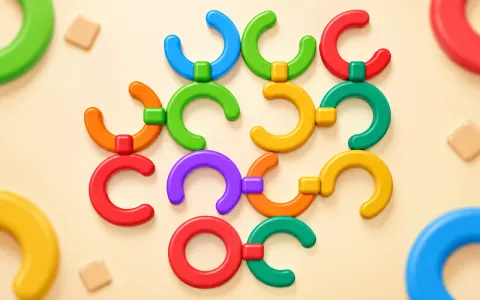 Ring TwistTurn the rings, slide the gaps, set them all freePlay now
Ring Twist comes down to one question: which ring should turn next? Every ring has a gap, and a clamp on one ring grips the band of its neighbour until that neighbour's gap comes round to it. To solve a board, start with a ring whose clamps grip nothing, turn it until its gap slides over a clamp on its band, and let whatever is no longer held fly off. If a ring will not turn, its own clamp is still gripping another ring, and the red glow on that clamp shows you which ring to free first. This guide covers how to read a board, why order beats speed, what to do with closed rings, and how the three stars are scored.
Read the board before you touch it
The rule is short. Each ring is an open band with a gap, and clamps fasten rings to each other: a clamp on one ring grips the band of the ring beside it. That grip holds until the gripped ring turns far enough for its gap to arrive at the clamp. Then the clamp lets go.
A ring flies away only when two things are true: none of its own clamps grips anything, and no other clamp grips its band. Sometimes one ring leaving removes the last grip on another, and that one leaves too. A single turn can start a chain that clears several rings, which is the best feeling in the game and the reason a quiet look at the board pays off.
Before the first turn, trace the grips. For each clamp, ask which ring it holds and which gap would release it. You are working out a dependency order, not hunting for a lucky turn.
Start with the rings that turn freely
A ring can only turn while its own clamps grip nothing. Rings like that are your first moves, and they usually sit at the edge of a chain, holding nothing and waiting to be turned out of the way of their neighbours.
Turn one by dragging it around its centre, or tap it to turn it to its next clamp. Dragging is better when you want to sweep the gap past more than one clamp, and one long turn can free several rings at once. Tapping is neat when you only need the next clamp and want to keep your turns tidy.
If you are unsure, begin at the outside of the picture and work in. A ring buried in the middle is almost always held by something on the rim.
When a ring will not turn, follow the red clamp
Sooner or later you drag a ring and it only wiggles. That is not a bug and it is not a missing move. A ring cannot turn while its own clamp still grips another ring, so it is held by the thing it is holding.
The clamp that causes this glows red. Look where it grips: the ring on the other end is the one you have to free first. Often that ring is itself held by another clamp, and the answer is a short chain of rings, each waiting for the next. Follow it to the end and the first ring you can actually turn is the real start of the solution.
This is why guessing is slow here. Turning rings at random changes which clamps are gripping and can bury the way out, while following the red glow gets you the right order directly.
Closed rings leave on their own
From level 6, some rings are closed all the way round, with no gap. A closed ring never turns usefully, so it is tempting to spend turns on it. Do not.
A closed ring leaves like any other: when no clamp grips its band and none of its own clamps grips anything. So the job is to free everything its clamps hold, and to release every clamp that grips it. Once that is done it lifts off by itself, and you did not spend a single turn on it.
Whenever you see a closed ring, treat it as a countdown. Count the rings it depends on, free them in order, and let it go last.
Stars, turns and the free tools
Each of the 200 levels was checked by a solver, so every board can be finished and the fewest turns it needs is known. Match that number and you earn three stars. Fewer turns than the solver is not possible, so the star count tells you how close your route was.
The levels start with two rings and grow to twenty-one, so early boards teach the grip rule and later ones reward planning the whole order in advance. Look for turns that do double duty: one sweep that releases a clamp and also brings the next gap into place.
There are also three tools below the board. Undo is free, so you can test a turn and take it back. Restart is there when a route has gone wrong. The bulb hint shows a good next turn. Use the bulb when you are stuck, then look at why that turn works; it teaches the order faster than another ten minutes of guessing.
If you like this kind of puzzle
Ring Twist is a calm, no-timer logic puzzle, and it shares its mindset with other crokocat games where the order of moves is the whole challenge. Bolt Out asks you to unscrew plates in the right sequence with only a few free holes, and Arrow Cube makes you clear arrows from the faces of a cube without blocking yourself. All three are free in the browser, with no download.
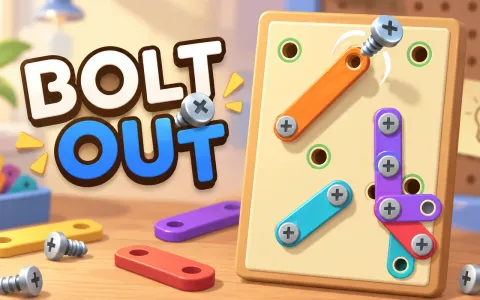 Bolt OutScrew puzzle — unscrew, move, drop every platePlay now
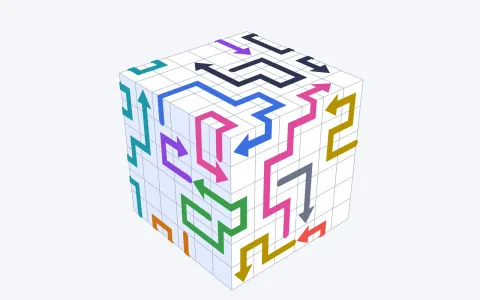 Arrow CubeClear every arrow off the cubePlay now
Frequently asked questions
Why won't my ring turn in Ring Twist?
Its own clamp is still gripping another ring. The clamp glows red, so look at the ring it holds and free that one first.
How do I turn a ring?
Drag it around its centre, or tap it to turn it to its next clamp. Undo, restart and the bulb hint sit below the board.
When does a ring fly away?
When none of its clamps grips anything and no clamp grips its band. Sometimes one ring leaving frees another, and a chain follows.
How do I get three stars in Ring Twist?
Clear the board in the solver's number of turns. Every level is checked by a solver, so that number is always possible.
Do I need to turn the closed rings?
No. Free everything their clamps hold and release the clamps that grip them, and they leave by themselves.
Guides & tips
Play it here
- Ring Twist — Turn the rings, slide the gaps, set them all free
- Bolt Out — Screw puzzle — unscrew, move, drop every plate
- Arrow Cube — Clear every arrow off the cube