


Go Arrows: how to clear the board and reveal the picture
Published October 18, 2026 · Updated October 19, 2026
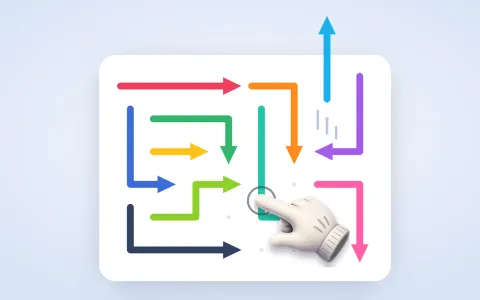 Go ArrowsClear the arrows, reveal the picturePlay now
Here is how Go Arrows works, in one breath: tap an arrow and it slides out along its own path in the direction its head points, but only if nothing stands on that line. If another arrow is in the way, yours bumps back and you lose one of your three lives. That is the whole rulebook, and it is the same one that drives Arrows GO! and Amaze GO. So the puzzle is not the tapping. It is the order you tap in, and every tip below is a way of finding that order faster.
The one rule: the head decides
Before every tap, run one silent check: where does this arrow's head point, and is the line from the head to the edge of the board clear? If yes, tap. If another arrow sits anywhere on that line, it blocks you, and the right move is to deal with the blocker first.
This sounds obvious until a long arrow curves across half the board. Its body can loop, bend and turn by forty-five degrees, and none of that changes where it goes when you fire it. The head is the only part that points anywhere. The tail simply tells you which cells the arrow occupies, which matters for a different reason: those are the cells it blocks for everybody else.
One more thing the rule gives you for free: firing never adds an obstacle. Every arrow you remove only opens the board, so a position that looks stuck is usually one clean tap away from unfolding. The skill is finding that tap.
Start at the rim
On a fresh board, look at the edge first. Arrows near the border that point outward usually have the shortest way out, often a single empty cell or none at all. Clearing them costs nothing and gives you the first gaps to work with.
Those early taps do more than lower the arrow count. Each one removes a body that was sitting on some other arrow's line, so the interior starts to loosen from the outside in. Think of peeling an onion rather than digging a hole in the middle.
Resist the urge to go for the satisfying long arrow in the centre first. If its path runs through the whole board, it will be blocked by four things at once, and you will spend a life learning that.
Break the standoffs
The tricky positions are mutual blocks: two arrows pointing at each other, or three in a loop where each one's head faces the next one's body. Nothing can fire until something else does, and staring at the pair will not help.
When you hit one, step back and look for a third arrow. In almost every standoff, one of the two has another blocker sitting further down its line, or has a different side that is already free once a neighbour leaves. Work out which arrow can leave first by following each head all the way to the edge, then count what is in the way. The arrow with the fewest blockers is the one to free.
A good habit: when you are unsure, trace the line from the head one cell at a time until you hit either the edge or another arrow. Whatever you hit is the blocker. It takes a second and it saves a life.
Your three lives are a budget
A bump-back costs one of three lives, and that is what turns careful looking from advice into a requirement. Treat the lives as a budget for reading mistakes, not as free retries. A good rhythm on easy boards is to tap fast, because the paths are obvious; on dense boards, slow down and trace the head's line with your eye before you commit.
If you do bump, use it. The arrow that stopped you is the blocker you missed, and it is now clearly the next arrow to deal with. Look at where yours stopped and free that spot before trying again.
Difficulty climbs in waves of five levels across the 500 in the campaign, from a dozen arrows to well over a hundred on the late boards, with fewer free arrows to start from. Expect the first tap on a late level to be harder to find than the next ten.
Zoom in on dense boards, and know the pictures
On the late levels the arrows sit so close that a fingertip can hit the wrong one. Pinch to zoom on a phone or scroll on desktop, and drag to pan while you are zoomed in. It feels slower, but a mis-tap on a crowded board can cost a life you had no reason to lose.
Every fifth level is a picture: an apple, a cat, a castle or a ghost, drawn along its own outlines with curved arrows. The original art shows through more and more as the board empties, which makes these levels a gentle breather and a good place to practise reading curved arrows. Colored boards, split into two to five ink colors, work under the same rule; the colors are decoration for the eye, not extra constraints.
Past level 500 the last hundred come back mirrored and rotated, so a board you have solved is a new puzzle in a different orientation. And if you want one board a day, the Daily Puzzle is the same colored board for everyone, with a week strip in the menu that tracks the days you solved.
Frequently asked questions
Why won't my arrow move in Go Arrows?
Another arrow is on the line its head points along. Find that arrow and clear it first, then come back to yours.
What happens when an arrow bumps back?
It stays where it was and you lose one of your three lives. Look at where it stopped: that is the blocker you need to free.
How many levels does Go Arrows have?
500 in the campaign, plus a Daily Puzzle every day. After level 500 the last hundred come back mirrored and rotated.
Is Go Arrows the same as Arrows GO!?
It follows the same arrow-puzzle idea: each arrow slides out in the direction its head points unless another arrow blocks the line. Go Arrows is crokocat's flat version, free in the browser with no download.
Does the game save my progress?
Yes. Your level is stored in the browser, so you can close the tab and continue later on the same device.
Guides & tips
Play it here
- Go Arrows — Clear the arrows, reveal the picture
- Arrow Cube — Clear every arrow off the cube
- Arrow Digger — Dig every cube out of the block
- UnTile — Send ants, clear the pixel art