


Find the Sheep: how to solve queens-style logic puzzles
Published August 16, 2026 · Updated August 18, 2026
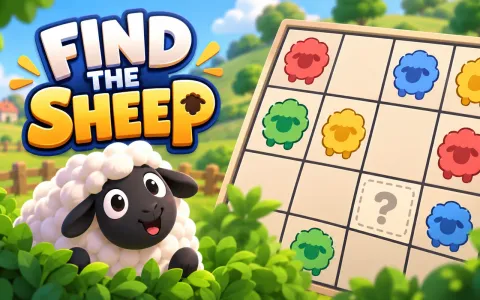 Find the SheepOne sheep per colorPlay now
A queens-style logic puzzle is solved by elimination, not by inspiration. Three rules govern the whole board — exactly one piece per colour region, exactly one per row and one per column, and no two pieces touching, not even diagonally — and every correct move is something those three rules already force. In Find the Sheep, the practical method is always the same: start with the most constrained colour region, cross out every tile the rules forbid, and only reveal a sheep when a region, row or column has exactly one legal tile left.
The three rules do all the work
Find the Sheep is a pasture split into coloured regions. Exactly one sheep hides in every colour, every row and every column, and no two sheep ever stand next to each other, even at the corners. That is the complete rule set. Everything you will ever deduce on an 8x8 board comes from those three lines interlocking.
It helps to notice that the rules count in three directions at once. A row must hold one sheep, a column must hold one, a colour must hold one. So every tile sits under three separate accounting systems, and any of the three can rule it out. Most players who stall are only checking one at a time.
The adjacency rule feels decorative and is not. A sheep claims not only its row and column but the whole ring of eight tiles around it — and on a crowded board that ring is often what removes the last ambiguity in a neighbouring colour. It is why one sheep so often unlocks two more.
Start with the smallest colour region
The opening move on any board is the same: find the colour with the fewest tiles. Fewer tiles means fewer places its sheep can hide, so that region carries the most information per glance. A colour of three tiles is a much better place to spend your attention than a colour sprawling across half the meadow.
From there, look for regions that sit entirely inside one row or one column. This is the single most productive pattern in the genre. If a colour occupies only tiles in row four, then its sheep is somewhere in row four — and since row four holds exactly one sheep in total, every other tile in row four belongs to no one. Cross the whole line out. You have not found a sheep yet, and you have still gained more than a reveal would have given you.
The same argument runs in the other direction. If a row has only one uncrossed tile left, that tile is a sheep. If a colour has only one uncrossed tile left, that tile is a sheep. Beginners hunt for sheep; strong players hunt for the moment a count drops to one, which is a much easier thing to see.
The cross is your thinking tool, not your answer
Tap any tile in Find the Sheep to mark an X where a sheep cannot be, and tap again to erase it. Marks are free, unlimited and carry no penalty — you can hold and drag across a run of tiles to sweep a whole line out in one stroke. There is no reason to keep deductions in your head when the board will hold them for you.
Treat the X as a record of reasoning rather than a guess. Every time you conclude something — this colour owns row four, this tile touches a sheep, this column is spoken for — mark it immediately. A board covered in honest crosses is one where the next deduction is visible instead of remembered.
Revealing works differently. Double-tap or double-click a tile (right-click also works on desktop) to reveal a sheep. When you are right, the game does the bookkeeping for you: it crosses off that sheep's row, its column, its colour and the ring of tiles around it, because the rules already settle those. What it will not do is make the deductions that require a decision. Those stay yours, which is exactly the right split.
The technique hard boards are built around
Sooner or later a board arrives where every row has several candidates, every colour has several candidates, and nothing is forced. That is when you need the argument that Find the Sheep screens its hard mode boards for specifically: proving a tile is impossible because of what a sheep there would do to somebody else.
The shape of the reasoning is always the same. Suppose a sheep stood on this tile. It would claim its row, its column and its eight neighbours. Now look at a nearby colour — does it have any tile left after that? If the answer is no, that colour would have nowhere to live, so the rules forbid a sheep here and the tile gets a cross. You have eliminated a tile without ever proving where a sheep is.
This is why the game's own advice is to ask what a sheep here would do to the neighbours before committing to a reveal. It also explains the difficulty curve. Boards from 4x4 up through the middle sizes usually fall to counting alone; on 8x8, and on every board in the hard track, the starvation argument is the technique the puzzle was checked against.
One habit makes it findable: when you are stuck, stop scanning the whole meadow and pick the two most cramped colours next to each other. Constraint failures happen where space is tight, so the tile that breaks the deadlock is usually in that neighbourhood.
Never guess — the maths is against you
A wrong reveal costs one of three hearts and restarts the level on the spot, crosses and all. Your remaining hearts carry over, and because every level is deterministic, the retry hands you the identical board — the puzzle that caught you is the puzzle you get to out-think. Burn all three and the flock scatters before your hearts refill for another run.
So a guess risks a full board of accumulated marks to save half a minute of thinking. That trade never pays, and it is unnecessary by construction: every board is dealt by a generator that verifies the solution is unique and replays it with a step-by-step logic solver first. If the solver would have to guess, the board is thrown away.
That changes how being stuck feels. Stuck never means the board is unfair; it means one cross has not been placed yet. Go back to the counting: smallest colour first, then rows and columns down to one candidate, then the starvation check on the tightest pair of regions.
Growing into the bigger boards
The levels scale deliberately. The 4x4 meadow boards teach the three rules, with the very first level showing you a sheep for free. Five-by-five boards are where single-row colours start doing the talking. Six-by-six asks for chained deductions, seven-by-seven for long elimination chains, and the endless 8x8 highlands run the full constraint orchestra at once.
There is also a separate hard track with its own progress, opening on 6x6 and reaching 8x8 by level 13. Every board on it is screened so basic counting alone will not finish the puzzle — the starvation argument is required, not optional. If normal boards have started falling quickly, that is where to go; your normal-track progress stays where you left it.
Progress and best level save on your device, and level N is the same board for every player, forever. That determinism is quietly useful: a board you failed is a board you can study, and beating it later means your technique improved.
Play it in your browser
Find the Sheep is free on crokocat with no download and no sign-up, on desktop, phone or tablet. Click to mark a cross and double-click or right-click to reveal; on a phone, tap to mark and double-tap to reveal, with the board sized for thumbs. Press R to restart a level on desktop.
If you want the same calm order-of-operations feeling with less counting, try UnTile — a relaxing ant colony puzzle where crews of worker ants carry a pixel art picture away tile by tile, and the whole game is deciding which crew to send when.
 UnTileSend ants, clear the pixel artPlay now
Frequently asked questions
How do you solve a queens puzzle?
By elimination, in a fixed order. Start with the colour region that has the fewest tiles, cross out every tile the rules forbid, and watch for any row, column or colour that drops to a single remaining candidate — that tile is forced. Only reveal when a count reaches one; never on a hunch.
What does one per row and column actually rule out?
More than it first appears. Once a sheep is placed, its row, its column, its colour region and all eight neighbouring tiles are settled. It also works in reverse: a colour that fits entirely inside one row owns that row, so the rest of the line can be crossed out before you know where the sheep is.
What do I do when I am completely stuck?
Take the two most cramped colour regions that sit next to each other and test tiles between them. Assume a sheep stands on a tile, apply its row, column and neighbour claims, and check whether a nearby colour is left with nowhere to go. If it is, that tile is impossible — cross it out. This is the technique hard boards are built around.
Do I ever have to guess in Find the Sheep?
No. Every board has a unique solution and is replayed by a step-by-step logic solver before it ships; boards that would require a guess are discarded. If nothing looks forced, a deduction is waiting somewhere you have not counted yet.
What happens if I reveal the wrong tile?
You lose one of three hearts and the level restarts immediately with the same board and your remaining hearts — crosses included, so a guess can cost a lot of accumulated work. Lose all three and the flock scatters, then your hearts refill and you get another attempt at that board.
Guides & tips
Play it here
- Find the Sheep — One sheep per color
- UnTile — Send ants, clear the pixel art