


Threadle: how to trace every word snake and fill the whole board
Published August 24, 2026
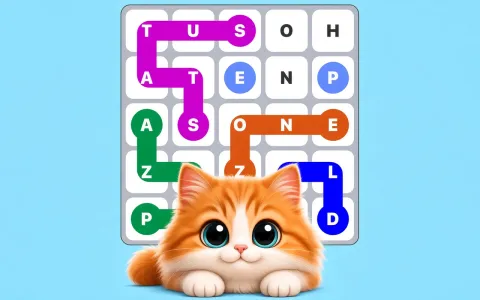 ThreadleTrace every word, fill the whole boardPlay now
A word snake puzzle plays by different rules than a word search, and the difference is the whole strategy. In Threadle, every letter on the board belongs to some hidden word, and every word winds through the grid like a snake — turning wherever it likes, covering its cells exactly once. Your job is to find where each word starts and ends and drag a path between the two marked dots, spelling the word along the way. Because the words tile the board perfectly, the game is less about vocabulary and more about logic: every word you trace fences in the ones you have not found yet. This guide covers the habits that keep a board moving — counting cells before guessing, tracing short words first, reading corners and forced letters — and how to survive once Threadle starts taking its hints away, level by level, all the way up its three thousand-board climb.
It is not a word search — the board is words all the way down
In a word search, words hide inside a soup of random filler and run in straight lines. Threadle inverts both rules: there is no filler at all, and nothing runs straight for long. Each board is a perfect partition — every cell belongs to exactly one word, every word is a bending path, and the board is solved only when all of them are traced. That single fact powers most of the deductions below.
The practical consequence: a letter you cannot place is never junk, it is a piece of a word you have not found. When some corner of the grid looks like nonsense, that is information — it tells you a word you know is sitting there in a shape you have not considered. Read the board as territory to be divided, not as a page to be scanned.
Count the cells first — the distance is the length
Two dots of the same colour are the head and tail of one word, and the word occupies every cell of the path between them. So before you guess at anything, count. If a pair of ends has four cells between the dots inclusive of both, you are looking for a four-letter word starting on one dot's letter and ending on the other's. That narrows the candidates enormously before you have traced a single cell.
The count also tells you how much the path wanders. If two ends sit three cells apart in a straight line but the word is seven letters long, the snake must fold back on itself to burn the extra length — expect turns. When the straight-line distance and the word length match, the path is direct. Doing this arithmetic first turns a blind drag into a plan.
Trace the shortest words first
Short words have few possible shapes: a three-letter word between two dots two cells apart can only bend one or two ways. Long words can coil through half the board. So start every level with the shortest pair you can find — it is the quickest to confirm and the cheapest to be wrong about in your head before you commit.
Every short word you lock in also does work on the rest of the board. Its cells are now walls: the longer snakes have to route around them, which cuts down where they can possibly go. Filling a board in Threadle is like a jigsaw where placing the small pieces shrinks the space the big ones must fit — the dozen-word boards late in the game are tamed exactly this way, one short fence at a time. On early boards the word list below is your ally here, and it stays sorted by length even after the hints thin out.
Corners and forced letters do the thinking for you
Corners are the cheapest real estate on the board. A path that enters a corner cell has only one way out, so whatever word owns that corner has its route through it decided in advance. When you are stuck, check the corners first: they often force the first few cells of a word for free, and edges are only slightly looser.
The same logic applies anywhere the board has been eaten up. A letter with only one free neighbour left must connect through that neighbour — there is nowhere else for its word to go. Late in a level these forced letters chain together: one forced cell decides the next, and a word you never guessed at simply draws itself. This is the quiet pleasure of the perfect-partition rule: the more you solve, the more the board solves for you.
The hints fade — build the habits before they are gone
Threadle's early boards are generous: every pair of ends shares a colour, and the full word list sits below the grid. That generosity is a loan. As the levels climb, the colours drop away, then the listed words shorten to their first and last letters, then to a single letter, and finally to nothing at all. By the late campaign you are reading the grid cold.
The mistake is to lean on the colours while they last and match dots by eye alone. Use the easy levels to practise the deductions that survive: counting cells, starting short, checking corners. When the colours vanish, pairing the dots becomes part of the puzzle — and cell-counting is how you do it, because only ends the right distance apart can belong to the same word. The players who struggle at level three hundred are the ones who never needed to think at level thirty.
One comfort as the boards grow from a four-by-four square with three words to a nine-by-ten grid packed with a dozen: the dictionary stays honest. Every answer is a common noun — no articles, no verb forms, no abbreviations — so a word you cannot see is always a word you know.
Three stars, and the two daily runs
A level finished without a single wrong guess earns three stars, which prices your habits directly: a speculative drag is not free, it is a star. When you are not certain, spend another few seconds counting instead. The forced-letter tricks above exist precisely so that certainty is usually available before you commit.
Beyond the campaign, Threadle runs two daily modes, and they reward different instincts. The themed survival run is five harder boards on a single subject with three lives for the whole run and no word repeated — knowing the theme is a hint in itself, since every answer belongs to it. The streak mode serves one level a day near your current progress and keeps a counter alive as long as you keep coming back; miss a day and it resets. Survival is where careless tracing gets punished hardest: a life lost on board one is a life you will want on board five.
Play it free in your browser
Threadle runs free on crokocat with no download and no sign-up, on desktop, phone and tablet — drag with the mouse or a finger from one end of a word to the other. Your level and stars are saved in your browser, and they follow you across devices if you are signed in. If the fence-building logic here suits you, Find the Sheep is the same pleasure in pure form — a queens-style puzzle with one sheep per colour, row and column and no guessing at all — and House of Secrets turns the read-the-board instinct toward triple-tile matching. Same portal, same no-install start.
 Find the SheepOne sheep per colorPlay now
 House of SecretsMatch three tiles, clear the boardPlay now
Frequently asked questions
How do you play a word snake puzzle like Threadle?
Every letter on the board belongs to a hidden word, and each word bends through the grid like a snake. Find the two dots marking a word's ends, then drag a path from one to the other that spells the word. Trace every word and the board is solved — no cell is filler.
What is the best strategy for Threadle?
Count the cells between a pair of ends first — that is exactly the word's length. Trace the shortest words early so they fence in the long ones, and let corners and letters with only one free neighbour force paths for you. Guess only when the count leaves one candidate.
How is Threadle different from a word search?
A word search hides straight words inside random filler letters. In Threadle there is no filler — every cell belongs to exactly one word — and the words turn corners. The board is only complete when every word has been traced.
How do I get three stars on a level?
Finish without a single wrong guess. Every speculative drag risks the third star, so verify with the cell count and the forced-letter logic before you commit a path.
What are the daily modes in Threadle?
Two run beside the 3,000-level campaign: a themed survival of five harder boards on one subject with three lives for the whole run, and a daily streak that serves one level near your progress and resets its counter if you miss a day.
Guides & tips
Play it here
- Threadle — Trace every word, fill the whole board
- Find the Sheep — One sheep per color
- House of Secrets — Match three tiles, clear the board