


Loop Belt: how to time your trays and sort every colour
Published October 8, 2026 · Updated October 13, 2026
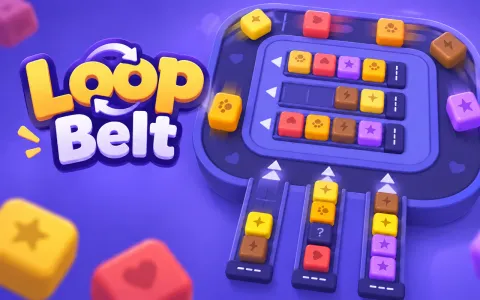 Loop BeltTap the trays, ride the belt, sort every colourPlay now
The core of Loop Belt is one habit: never send a block onto the belt unless you know which tray will take it. Tap a tray and its top blocks ride the loop, drop into the first tray whose top block matches and has room, and four of one colour clear away. Blocks with nowhere to go keep circling and eat belt space, and when the belt overflows the level ends. So the winning approach for conveyor sorting puzzles like Loop Master is the same in every level: empty one tray early, send out runs that already have a home, and wait for the belt to clear before you tap again. This guide shows how to apply that, how to read the dots at the top, how to handle hidden blocks and what earns three stars.
Know where every block will land
Each tray holds up to four blocks in a row, and the block at the belt end is the top one. When you tap a tray, its top run of one colour slides out. As the belt carries a block past the trays, it drops into the first tray whose top block is the same colour and which has room. If no tray wants that colour, it drops into an empty tray instead.
That rule is the whole puzzle. Before every tap, name the destination out loud: this red run goes to the tray with red on top. If you cannot name it, the blocks will not land, they will circle, and each one occupies a spot on a belt that only holds so many.
A good first scan of a level is not about the belt at all. Look across the trays for colours that already sit on top of two different trays, because those are the safe taps, and for colours that appear on top of no tray, because those blocks have nowhere to go yet.
Open with an empty tray
An empty tray takes any colour nobody else wants, so it is your only flexible space. The first goal of most levels is to create one: pick a tray with a short run on top, send it to a tray that already shows the same colour, and watch the gap appear.
Once you have an empty tray, spend it on purpose. Dropping a stray colour into it is fine if that colour will soon collect more blocks; dropping a one-off colour into it just trades one blocked tray for another. Think of the empty tray as a spare hand, not as a place to dump leftovers.
Early on, the easiest tray to empty is usually the one whose top colour already has a home on another tray. That is also the tip the game itself implies: tap a tray whose top colour already has a place to go.
Read the dots, then wait for the belt
The belt is the limit in Loop Belt. It only holds so many blocks, and the dots at the top show how full it is. Send out blocks that have nowhere to go and they just ride round and round, taking up space. Send out more than the belt can hold and it overflows.
The cheapest habit in the game is patience. After you tap, let the blocks land before you tap again. Waiting for the belt to clear costs nothing, and the second run you send then has a clean belt and a tray that has just opened up.
Keep a couple of dots free as a buffer. Some blocks are hidden, and a surprise colour that fits no tray needs somewhere to circle until you make room for it.
Finish one colour at a time
Four of a kind in a tray clear away, and clearing frees a whole tray. That makes it better to complete one colour than to spread many half-finished colours across every tray.
In practice: choose the colour with the most blocks already visible on tray tops, send those runs so they gather in one tray, and let the clear open your next empty slot. Then pick the next colour. A board where every tray holds a mix of two or three colours is exactly the board where blocks start circling.
If two colours both look ready, take the one whose clear will reveal a useful colour underneath, since the block under a cleared run becomes the new top.
Hidden blocks, new belts and later levels
Later levels bring more colours, more trays, a shorter belt and blocks hidden under question marks until they reach the top of their tray. A hidden block shows its colour only when you uncover it, so do not plan around it. Plan for the visible tops, keep your buffer, and treat each reveal as new information.
The belt also changes shape from level to level: a rounded box, a figure eight, a U with an entry and an exit gate, a straight bar, a wave, an arch or a hook. The rule stays the same, but a short belt has fewer dots, which makes the empty-tray habit and the wait-before-tapping habit matter even more.
Trays are numbered in belt order, so on a keyboard you can press 1 to 9 and 0 to tap them. That helps when you want to fire several quick, planned taps without moving the mouse.
Stars, hints and the overflow rescue
Stars reward a tidy belt: finish without ever crowding it for three. That means the three-star play is usually the slow, patient one, not the fast one.
If you are stuck, the bulb points at the tray to tap next, and a short video tops up your hints. If the belt overflows, a video adds two belt spaces once per level so you can keep going. Use the hint when you have no safe tap, not as a first move, since the real skill in this puzzle is naming each block's destination before it leaves the tray.
Frequently asked questions
Where do blocks go when they leave the belt?
Into the first tray they pass whose top block is the same colour and has room. If no tray wants that colour, they drop into an empty tray.
Why did my level end?
The belt overflowed. It holds only so many blocks, and the dots at the top show how many. Blocks with nowhere to go keep riding and take up space.
How do I get three stars in Loop Belt?
Finish the level without ever crowding the belt. Send only runs that have a home and wait for the belt to clear between taps.
What are the question-mark blocks?
Hidden blocks. They show their colour when they reach the top of their tray, so keep a few belt dots free for surprises.
What should I do first in a new level?
Create an empty tray by sending a short top run to a tray that already shows the same colour. An empty tray takes any colour nobody else wants.
Guides & tips
Play it here
- Loop Belt — Tap the trays, ride the belt, sort every colour