


Last Peg: how to solve peg solitaire down to one marble
Published October 23, 2026 · Updated October 25, 2026
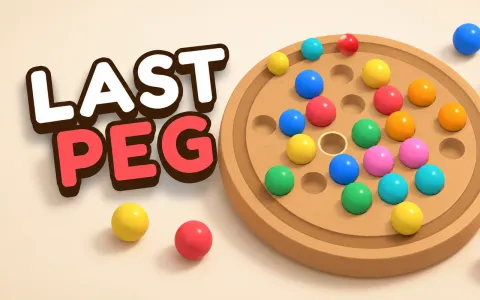 Last PegPeg solitaire — jump until one marble is leftPlay now
The short answer to how to solve peg solitaire: clear the edges and corners first, keep your marbles in one connected group, and never jump a marble away from the crowd. Every jump removes one marble, so the whole puzzle is about choosing jumps that leave the next jump possible. Last Peg is a free peg solitaire with glass marbles on a round wooden board, and every level in it can be solved, which makes it a good place to practise the habits below: clearing edges, working in blocks of three, reading the hint bulb and counting neighbours near the end.
Know the rule, then know why you get stuck
In Last Peg you tap a marble, then tap the glowing hole it jumps to. The marble hops over its neighbour into an empty hole behind it and the neighbour you jumped is taken. Jumps go up, down, left and right, never diagonally. You win when a single marble is left. A marble that has only one possible jump goes at once, so you do not need to tap the hole.
Because every jump removes a marble and needs an empty hole on the far side, the board gets sparser with every move, and sparse boards strand marbles. You get stuck when two marbles end up far apart, or when a marble sits in a corner with no neighbour to jump over. Almost every failed attempt is a stranded marble, not a bad last move. So the plan is to keep the whole board connected for as long as possible.
Last PegPeg solitaire — jump until one marble is leftPlay nowClear the edges early
The first tip in Last Peg is also the most useful one: clear the edges early. A marble on the rim has fewer neighbours than one in the middle, so it has fewer chances to jump and fewer chances to be jumped. If you leave it until late, the marbles around it are probably gone and it cannot be reached.
Corners are the worst case. A marble in a corner or at the tip of an arm of the board can only be taken by a jump along the edge, which needs a marble next to it and an empty hole on the other side. Plan the corners while the board is still full, because that is when the neighbours exist. Use the middle marbles as the tools that clear the rim, and keep the centre for last.
Keep your marbles together
A lone marble far from the rest of the board cannot be taken and cannot take anything. A solved board is one group that kept shrinking, so every jump should shrink the group rather than split it.
Before each jump, look at what it leaves behind. If the jumped marble was the only link between two clusters, the cluster you are not working in is now cut off. Prefer jumps that stay inside the main body of the board, and choose the order of two possible jumps by asking which one leaves fewer marbles with no neighbours.
Work in blocks of three
Peg solitaire breaks into small patterns. Two marbles in a row with a hole after them are a block of three squares: one jump clears the pair. A small group can often be cleared with two jumps if you set it up so the second marble lands where the first one jumped from.
Look at the board as a set of blocks of three squares rather than as a pile of separate marbles. When a group of three fits a jump, ask whether that jump also opens a hole that makes the next group playable. Chains of such jumps are how a cluttered area gets cleared without leaving strays.
Use undo, restart and the hint bulb
Last Peg lets you undo any jump, restart the level, or tap the bulb for a move. The bulb has a second job that matters more: it tells you when the board can no longer be finished. That is a real tool. Many peg solitaire boards look alive for several moves after they are already lost, and the bulb ends that guessing.
If the bulb says the board cannot be finished, undo until it can. Undoing one jump at a time is faster than restarting, and it shows you where the position went wrong. A level gives three stars for a clean solve with no undo or hint, so use the tools freely while you learn and go for stars once a level feels familiar.
The endgame: count the neighbours
Near the end, tips turn into counting. List the marbles that still have a neighbour next to them, and check that each one has an empty hole behind that neighbour. A marble with no neighbour is already lost; a marble with exactly one possible jump is a forced move and Last Peg plays it for you as soon as you tap it.
Levels start with a handful of marbles and grow towards a nearly full board, and some use the rounder European board instead of the English cross. The rules do not change, but a different layout changes where the corners are, so look at the edges again before the first jump. Every level is built backwards from a single marble, so a solution always exists. If the position looks hopeless, it is a sign that an earlier jump broke the connection, not that the level is broken.
Frequently asked questions
Is there a guaranteed solution to peg solitaire?
In Last Peg, yes. Every level is made by undoing jumps from a single marble, so each one can be solved. The bulb tells you if your current position can no longer be finished.
Which marbles should I jump first?
Start with marbles on the edges and in the corners. They have the fewest neighbours, so they are the hardest to remove late in the game.
Can I jump diagonally in Last Peg?
No. Jumps go up, down, left and right only.
What does the hint bulb do?
It shows a good jump, or tells you that the board can no longer be finished so you should undo.
How do I get three stars?
Solve the level cleanly, with no undo and no hint.