


Grid Zen: sudoku solving techniques that never need guessing
Published September 27, 2026 · Updated October 2, 2026
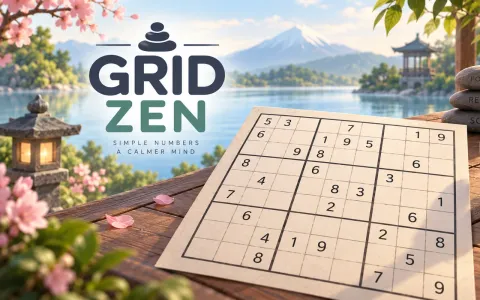 Grid ZenSudoku on soft 3D tiles — one answer, no guessing, three heartsPlay now
The fastest way to solve sudoku without guessing is to stop looking at the grid as a whole and start looking at one tile, one row, one box at a time, asking a single question: what is the only digit that can go here, or the only place this digit can go? That question, asked over and over, is the entire technique — no guessing required, because Grid Zen only serves puzzles that a logical solver can already finish using exactly this kind of reasoning. The rule never changes: fill the empty tiles so every row, every column and every 3×3 box holds each digit from 1 to 9 exactly once. What changes as you climb the levels is how much the puzzle is willing to hand you outright, and this guide covers the techniques that carry you from the easy end of that ladder to the hard end, plus what the hearts, notes and hints actually do while you're solving.
One rule, checked three ways
Every tile in Grid Zen belongs to three groups at once: its row, its column and its 3×3 box. The rule is that each of those nine-tile groups needs every digit from 1 to 9 exactly once, no repeats. Tap a tile to select it and the game lights up its row, column and box for you, along with every other tile already holding the same digit — which is the game doing the first, most tedious part of sudoku by hand for you.
That highlighting is worth using deliberately, not just glancing at. Before placing a digit, look at what's already lit: if a 7 is lit in the row, the column and the box, that tile cannot be a 7, and you've just eliminated one of nine possibilities without any guessing at all. Do that for a few digits and a tile's real options usually shrink to one or two very fast.
The two techniques that solve most of the puzzle
On the early levels — Grid Zen leaves more than forty digits already filled in at that end of the ladder — almost everything solves with two ideas. The first is a single candidate: look at one empty tile, cross off every digit that already appears in its row, column or box, and if only one digit survives, that's the answer. The second is a single position: look at one digit instead of one tile, and check where in a row, column or box it could still legally go. If every tile but one is already ruled out, that tile has to be it.
These two techniques are really the same elimination viewed from two directions — tile-first or digit-first — and switching between them is what keeps a puzzle moving when one angle stalls. A tile that looks ambiguous from its own row can be pinned down instantly once you check the same tile from its box, or from the digit's perspective instead of the tile's.
When clues thin out: pointing pairs and naked pairs
Further up the ladder, the puzzle stops handing you enough for single candidates and single positions alone, thinning down toward twenty-seven starting digits, and that's where pointing pairs and naked pairs come in. A pointing pair is two tiles in the same box that are the only ones a digit could occupy, and if those two tiles also share a row or column, that digit can be crossed off every other tile in that row or column — because one of the pair has to take it.
A naked pair works the other way: two tiles in the same row, column or box that both have exactly the same two candidate digits left. Neither tile can be solved yet, but between them they've claimed both digits, so those two digits can be eliminated from every other tile in that group. Grid Zen never sends you a puzzle that needs more than a human solver could reasonably work out with techniques like these — every puzzle is checked in advance to make sure it's solvable without ever having to guess.
Using notes without drowning in them
Switch the input pad to the pencil and you can jot small candidate digits into a tile instead of committing to one. The useful habit is narrow, not exhaustive: note down only the two or three digits you've actually ruled everything else out for, on the specific tiles where a pointing or naked pair is close to breaking open, rather than filling every empty tile with every remaining possibility.
The game does some of the bookkeeping for you — placing a digit removes it automatically from the notes of every tile it rules out, so a well-timed note doesn't turn into stale clutter the moment the board moves on. The pad itself also tracks how many of each digit are still missing from the whole grid, and a digit disappears from the pad once all nine copies are placed, which is a fast way to see which digits are worth hunting for next.
Hearts, hints and the three stars
You get three hearts per level. Placing a wrong digit costs one, flashes red, and the tile empties again; lose all three and the level restarts. That makes hearts a reason to slow down on a tile you're not sure about rather than a punishment for being wrong — check the row, column and box highlighting again before committing, especially once you're down to your last heart.
One hint is free every level and fills in a tile of your choice, useful for breaking a genuine stall rather than for tiles you could work out with another minute of looking. Three stars needs a clean run: no wrong digits and no hint used. A one-heart-lost finish still clears the level, so treat three stars as a target for a second attempt rather than something to force on the first.
Playing on phone, tablet or keyboard
The board, tiles and digits are all drawn in 3D right in the browser, sized to hold comfortably upright on a phone, with nothing to install. Tap a tile, then a digit on the pad below; the eraser clears a tile's notes if you've changed your mind about a candidate.
On a keyboard the same actions map to arrow keys to move between tiles, 1 through 9 to enter a digit directly, N to toggle notes mode, and Backspace to clear a tile's notes — worth learning if you're solving on a desktop, since it's noticeably faster than clicking the on-screen pad for every entry.
Frequently asked questions
Do you ever have to guess in Grid Zen?
No. Every puzzle has exactly one answer and is checked before it reaches you to make sure a solver using only human techniques — single candidates, single positions, pointing pairs, naked pairs — can finish it without guessing.
What's the fastest way to start solving a Grid Zen puzzle?
Tap a tile to see its row, column and box light up along with matching digits elsewhere on the board, then eliminate: cross off any digit already lit nearby. On early levels, that alone plus checking where a digit still has room to go (single candidate and single position) solves almost everything.
What do the hearts and hints do?
You have three hearts per level; a wrong digit costs one and empties the tile, and losing all three restarts the level. One hint is free per level and fills in a tile of your choice. Neither is required to finish a level, but using either affects your star count.
How do you get three stars on a level?
Finish with no wrong digits placed and no hint used. Clearing the level any other way still counts as a win, so three stars is worth treating as a goal for a replay rather than something to chase on the first try.
Can I play Grid Zen with a keyboard?
Yes. Arrow keys move between tiles, number keys 1 to 9 enter a digit directly, N switches the pad to notes mode, and Backspace clears a tile's notes — all in addition to tapping the on-screen board and pad.
Guides & tips
Play it here
- Grid Zen — Sudoku on soft 3D tiles — one answer, no guessing, three hearts