


Water Maze guide: read the maze before the water reaches the valve
Published September 15, 2026
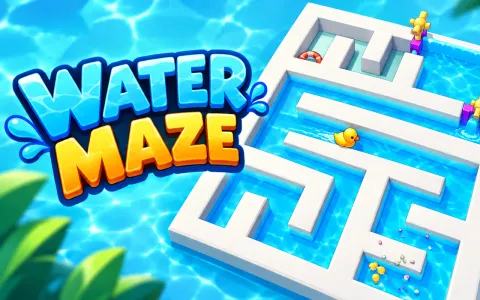 Water MazeTurn the valves, send the water to the flowerPlay now
Water Maze is a water puzzle that looks like a toy and plays like a budget. A tank of water starts pouring the moment a level opens, a flower somewhere at the bottom of the maze needs that water, and the only thing you control is which way each valve points. The trap is treating it as a reflex game — tapping valves as the stream reaches them. That clears the easy levels and then hits a wall once drains and pits start showing up together. The players who reach level 300 read the whole maze in the first second, decide the route, and only then start tapping. This guide is about that habit and the handful of rules that make it work.
The first second is the only free one you get
Every Water Maze level starts the same way: the water is already running. There's no ready screen and no countdown — the stream leaves the tank as soon as the maze appears. That's not a bug to fight, it's the entire puzzle. A valve is only worth turning while the water is still on its way to it; once the stream has gone past a junction, that junction is settled and nothing you tap there changes anything.
So the real skill is not tapping fast, it's looking fast. Before you touch a single valve, find three things: where the flower is, where the drains are (the red rings), and which valves sit on the path between the tank and the flower. On early levels that's a straight corridor with one valve. On later levels the maze is taller than the screen, and the drain you didn't see is nearly always the one that was off-screen — so drag the box and scroll through the whole level first, even though the water is running. A lost second of water is cheaper than a lost tank.
Restarting costs nothing. There are no lives, no energy, no timer beyond the water itself, and a level takes about a minute. If a first attempt ends without a clear picture of the route, treat it as reconnaissance and go again — the second run is always clearer than the first.
Water only goes down and sideways
The rule that shapes every route: the stream never climbs. It moves down and sideways, and a corridor above the water's current position is one it will never reach. Obvious, and still the thing people get wrong, because a maze drawn in 3D makes it easy to imagine a path that flows uphill.
Use it to prune the maze. Anything above the stream is dead — ignore it. That usually leaves two or three real routes from tank to flower, and a valve or two that actually decide between them. Every level is solvable, so if you can't find any route, you've missed a corridor, not a rule.
Each valve swings between the two corridors leaving that junction: straight on, or off to the side. Think of a valve as a switch for the stream rather than a gate — it never stops the water, it only chooses where it goes next.
The counter at the top is your budget
The number at the top of the screen is how much water is left in the tank, and it only ever goes down. Every cell the stream fills spends some of it. The flower doesn't need a particular amount — it needs the water to arrive before the tank is empty — so a level is really a question of whether your route costs less than what's in the tank.
Drains are the expensive mistake. Water that reaches a red ring runs out of the box and never comes back. But a drain doesn't always have to be avoided; sometimes a long detour around one costs more water than the drain would swallow. Weigh it. The question is never 'is there a drain on this path?' but 'what does this path cost in total?'
Pits are the other cost. A deep section has to fill to the brim before the water carries on past it, so a pit on your route is a large one-time payment out of the tank. Check whether a side corridor bypasses it; if not, make sure nothing else on the route is bleeding water at the same time, or the tank runs dry with the pit half full.
When the stream splits at a junction, both halves drink from the same tank. Shutting one branch off with a single valve turn is very often the whole solution to a level that looked complicated.
A route-planning routine that holds up at level 200
Here is the sequence that stops working only when you stop doing it. One: scroll the whole maze and find the flower. Two: note every drain and pit. Three: trace backwards from the flower to the tank, going only up and sideways, and find the cheapest route — fewest pits, no unnecessary drains. Four: list the valves on that route and the state each one needs to be in. Five: tap them in the order the water will reach them.
Step five is where people slip. It's tempting to tap the nearest valve first, but the stream reaches valves in a specific order, and a valve far down the maze can wait. Turn the ones the water will hit first, then follow the stream down. If two valves are close together and the water is already near, get the upstream one right and accept that you might lose the second — that costs you a one-tap restart, not the run.
Later levels stack several tanks, overflow pools in the middle, and drains sitting exactly where you were about to send the stream. The routine doesn't change; the maze just has more junctions to list.
Duck levels: solve the duck, not the flower
Every fifth level belongs to the duck. She floats wherever the current takes her and can't swim back, so the level is only won when the water carries her home to her ducklings as well as reaching the flower. This changes the shape of the puzzle more than it first seems.
On a normal level there are usually several routes that water the flower. On a duck level there's usually only one route that carries the duck home, and it may not be the cheapest route to the flower at all. So flip the order: work out the duck's route first, then check whether that same stream also reaches the flower or whether a second branch is needed. Planning the flower first and bolting the duck on afterwards is how you end up with a happy flower and a duck in a dead-end pool.
Because the duck can't go backwards, any valve she has already passed is irrelevant to her — the same 'settled junction' rule applies. And yes, there are hearts when she gets there. These are the levels people replay from the level picker for the sheer pleasure of it.
Play Water Maze free in your browser
Water Maze runs on crokocat with no download and no sign-up, on desktop, phone and tablet. It's a click to turn a valve on desktop and a drag to scroll a long maze; on a phone it's a tap and a one-finger drag, built for one thumb in portrait. Progress is saved automatically, and the Levels button opens a picker with every level you've cleared, so you can replay a favourite duck level or pick up where you stopped. Three hundred levels, all solvable, made by crokocat in 2026.
If it's the routing-and-budgeting itch that got you, a few neighbours on the portal scratch it from other angles. Rainbow Sort drops rolling marbles from trays onto a moving conveyor and asks you to pack each one into the box of its own colour before the belt jams — the same question about committing space, at speed. Gem Sort is the flask-and-pour classic: gems land only on their own colour, one pour at a time. Puzzle Drop is a jigsaw played with falling cards, each carrying a quarter of a picture, with a Daily 6×6 that's the same for everyone.
 Rainbow SortRoll every marble into its colorPlay now
 Gem SortSort the sparklePlay now
 Puzzle DropA falling-card jigsaw, new puzzle dailyPlay now
Frequently asked questions
How do you play Water Maze?
Get the water from the tank to the flower before the tank runs dry. Tap or click a valve to swing it between the two corridors leaving that junction, and turn it before the stream reaches it — once the water is past a junction, that junction is settled. Drag the box to scroll a long maze.
Why does the water start before I've done anything?
That's the puzzle. The stream runs from the moment the level opens, so a valve only matters while the water is still on its way to it. The trick is to read the whole maze in the first second, find the flower and the drains, and then tap the valves in the order the water will reach them.
What are the red rings and the deep sections?
Red rings are drains: water that reaches one runs out of the box for good, so routing the stream past a drain is the most expensive mistake in the game. Deep sections are pits: the water has to fill a pit to the brim before it carries on, so a pit on your route is a big one-time cost from the tank.
How do the duck levels work?
Every fifth level has a duck who drifts with the current and can't swim back. The level is won only when the water carries her to her ducklings as well as reaching the flower. Solve the duck's route first — plenty of routes water the flower, usually only one brings her home.
Is Water Maze free, and is my progress saved?
Yes on both. It's free in your browser on crokocat with no download and no sign-up, and it saves the level you're on and the highest one you've cleared on your device. The Levels button lets you replay any level you've already beaten.
Guides & tips
Play it here
- Water Maze — Turn the valves, send the water to the flower
- Rainbow Sort — Roll every marble into its color
- Gem Sort — Sort the sparkle
- Puzzle Drop — A falling-card jigsaw, new puzzle daily