


Sort puzzle strategy: never get stuck again
Published August 24, 2026 · Updated September 2, 2026
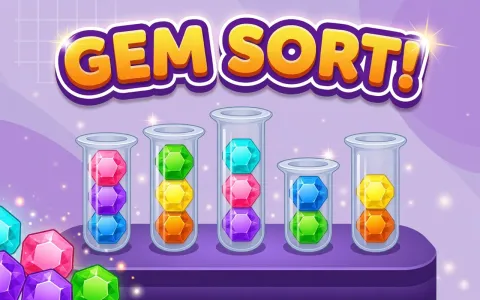 Gem SortSort the sparklePlay now
Every sort puzzle — water sort, ball sort, or Gem Sort with its flasks of faceted gems — runs on one rule: a piece lands only on its own colour or in an empty container. All useful strategy follows from a fact hiding inside that rule: your empty flasks are the only working space you have, and nearly every board that locks up is a board where that space was spent carelessly. The tips below are about protecting it — which colours to dig out first, which pours quietly waste a flask, and how to use Gem Sort's unlimited undo so that “stuck” stops being an ending and becomes part of the thinking.
One rule, four gems, two empty flasks
Gem Sort keeps the classic sort-puzzle rules intact. Each flask holds four gems. A gem can move only onto a gem of the same colour or into an empty flask, and matching gems sitting together on top travel as one pour. Fill a flask with four of a kind and it locks in with a flash; sort every colour into its own flask and the level is done. You start with the mixed flasks plus two empty ones — and those two empties are the entire budget the puzzle gives you.
Notice what the rule makes cheap and what it makes expensive. Pouring onto a matching colour costs nothing: the gems consolidate and no space is lost. Pouring into an empty flask spends your scarcest resource, even when it looks harmless. That asymmetry is the whole game. Strong players make lots of matching pours and very few pours into empties; weak players do the opposite, and three moves later nothing on the board can move at all.
Guard your empty flasks — they are the only resource
The trap every sort-puzzle veteran knows: the board offers you an easy pour into an empty flask, you take it because it feels like progress, and a minute later you are staring at a layout where nothing moves. Free space spent without a purpose does not come back on its own — you only reclaim it by completing colours, which is exactly what you can no longer do once the space is gone.
So make every pour into an empty flask pay for something specific. Good reasons: it uncovers a colour you can consolidate on the next move, it reunites a colour that is split across several flasks, or it starts a stack you can finish to four quickly. If a pour into an empty does none of those, it is not a move — it is a loan against a board that will collect later.
A related habit worth breaking: spreading effort across many half-sorted flasks. Two flasks each holding two gems of different colours tie up the same slots as one completed flask and one empty — but the completed flask is locked in and finished, while the half-sorted pair is just clutter that still needs solving. Commit to a colour, finish it to four, bank the flash.
Dig out the deepest colours first
Look at the bottom row of the board before your first pour. Colours buried at the bottom of full flasks are the ones that will need the most excavation, and excavation needs room — so do that digging early, while both empties are still available and the top layers are still loose. A buried colour ignored until the endgame is the classic way to lose a board you were winning.
This is what “plan two pours ahead” actually means in a sort puzzle. It is not about calculating deep lines; it is about checking what each pour uncovers. The best move is often not the one that matches a colour right now but the one that frees a useful gem underneath — a match that also exposes another match is worth two of a match that exposes a colour you cannot place.
Levels in Gem Sort grow from a gentle three colours up to a dense eight, and the deeper boards are where this habit starts deciding games. With eight colours in play, surface-level matching runs out fast; the players who survive are the ones who chose their excavation targets in the first few moves.
The stray-gem trap
Here is the mistake that quietly kills more boards than any other: stacking a colour on top of a single stray gem that you will need to move again. The stack above it may be beautifully matched, but that lone gem at the bottom is now sealed under three or four pieces of a different colour — and unsealing it later will cost you an empty flask at the exact moment you have none to spare.
Before you pour onto a matching gem, glance at what sits underneath the stack you are building. If the bottom of that flask holds a stray that belongs elsewhere, consider sending your gems to a different matching stack, or into an empty if the stray is one you can rescue right away. Burying it deeper is the one choice that only gets more expensive with time.
Undo is a thinking tool, not an admission of defeat
Gem Sort's undo is free and unlimited, and that changes how you should play. Instead of staring at a tangled board trying to simulate five pours in your head, try the line on the board: pour, read the result, and roll it back if it disappoints. The undo button turns the puzzle from a memory exercise into an experiment bench — use it the way a chess player uses analysis, not the way a gambler uses a mulligan.
Restart is equally honest here: it replays the same deal rather than reshuffling, so restarting is a real strategy for a board you now understand better, not a slot machine pull for an easier layout.
And one fact that should change your relationship with being stuck: every Gem Sort level is generated and then verified by a solver before you ever see it. There are no dead deals. If nothing seems to work, the way out exists — undo a few moves back to where the board still had options, and look for the pour you dismissed the first time.
Play it in your browser — and try the moving version
Gem Sort is free on crokocat, with no download and no sign-up: click flasks with the mouse on desktop, or tap them on a phone or tablet, and your level number saves automatically between visits, so an abandoned board is still waiting in the evening.
When flask-sorting starts feeling comfortable, Rainbow Sort on the same portal is the same colour-sorting itch with a clock attached: marbles roll from trays onto a moving conveyor, and you steer each one into the box of its colour before the belt fills up and jams. Everything you practised here about protecting space transfers directly — except the board no longer waits while you think, so timing joins the puzzle as a second axis.
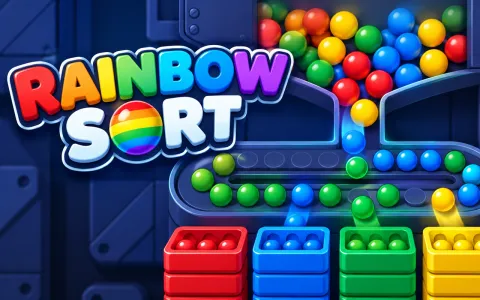 Rainbow SortRoll every marble into its colorPlay now
Frequently asked questions
What is the best strategy for sort puzzles like water sort or ball sort?
Protect your empty containers and only pour into them for a concrete reason, dig out the colours buried at the bottom early, avoid stacking a colour on top of a stray gem you will need later, and prefer moves that uncover something useful over moves that merely match.
Are Gem Sort levels always solvable?
Yes. Every deal is generated and then checked by a solver before it reaches you, so there are no dead levels. If you are stuck, the way out exists — undo a few moves and look again.
What should I do when I get stuck in a sort puzzle?
In Gem Sort, undo is free and unlimited, so roll back to the point where the board still had options and try a different line. Restart replays the same solvable deal rather than reshuffling, so restarting a board you now understand is a real strategy too.
How many gems fit in one flask in Gem Sort?
Four. Matching gems sitting together on top move as one pour, and filling a flask with four of a kind locks it in. Levels grow from three colours to eight, and your progress saves automatically.
Is Gem Sort free to play?
Yes — Gem Sort runs free on crokocat, entirely in your browser, with no download and no sign-up, on desktop, phone or tablet.
Guides & tips
Play it here
- Gem Sort — Sort the sparkle
- Rainbow Sort — Roll every marble into its color