


Bus Jam guide: how to clear levels without jamming the queue
Published August 29, 2026
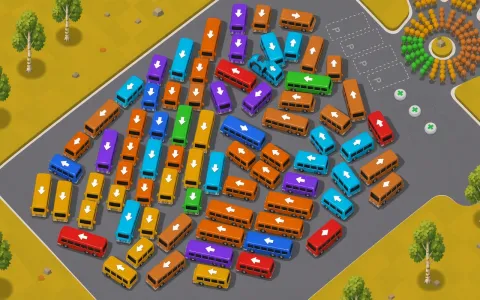 Bus JamDig out the right bus before the queue jamsPlay now
Most Bus Jam levels are not lost to a bus you could not reach — they are lost to a bus you sent out too early. Tapping a bus makes it drive straight ahead, and if it gets out it parks in one of your four bays and holds that bay until enough passengers of its colour board it. So the skill is not digging; it is deciding which colour is allowed to occupy your parking, and in what order. This guide covers the movement rule, bay management, the two ways a level can deadlock, when an extra bay is worth its coins, and how to handle the VIP levels that start at 25.
The one movement rule everything else hangs off
A bus only ever drives in the direction it is already facing. Tap one with a clear lane ahead and it pulls out of the lot; tap one with anything in the way and it shakes and stays where it is. There is no reversing, no turning, no dragging — the angle a bus was parked at is its only exit.
That makes the lot readable if you look at noses rather than at colours. Before your first tap, scan for the buses whose facing direction is already clear, because those are your entire set of legal moves right now. Everything else is locked behind them, and freeing a locked bus is a matter of removing whatever sits in its lane — which is not always the bus nearest to it.
Layouts are generated from the level number and every one is verified solvable before it ships, so a level you cannot finish is one you played in the wrong order, not a broken deal. That is also why replaying pays: level 137 is the same 137 on your phone as on your laptop, so a second run starts with everything the first one taught you.
Your four bays are the real resource
You start every level with four parking bays. A bus that leaves the lot takes one and keeps it until it fills up and drives away — and it fills up only with passengers of its own colour, who arrive on the ring turning around the lot. Nothing you do can evict a parked bus early.
So each tap spends a quarter of your parking on one colour. Send out a bus whose colour is nowhere near the ring and you have not made progress; you have made yourself smaller. Two of those in a row and you play the rest of the level with half the parking you were given.
The habit worth building is checking the ring before you check the lot. Look at which colours are actually coming round, then find the bus that serves them. When you cannot serve anything on the ring, the correct move is usually to dig — send out the buses that unlock the most lanes rather than the ones that look convenient.
The two deadlocks and how to see them coming
The first is the parking deadlock: the ring is full, none of the buses in your bays match a colour on it, no bay is free, and you cannot afford to open one. Nothing can move, so the level ends and you restart it. This is the loss you cause yourself, and it always has a warning sign — a bay holding a colour the ring has stopped producing.
The second is simpler and rarer: the colour the queue still needs no longer exists anywhere, not in a bay, not in the lot, not in the buses still to arrive. If you see a colour on the ring you cannot match, count what is left of it in the lot before spending bays on anything else.
The practical defence against both is the same. Keep at least one bay empty as long as you can afford to — an empty bay is an option, a bay with a stalled bus is a liability — and prefer clears that finish a bus over clears that start one. A bus that drives away costs you nothing and gives the bay back.
Coins, extra bays and when to actually buy one
Departing buses pay by size: five coins for a big one, three for a medium, one for a small. Clearing a level for the first time pays fifty, and replaying it later pays ten — so grinding an easy level is not a coin strategy, and the campaign itself is your income.
Coins buy extra bays, three of them, taking you from four to a maximum of seven. They unlock one at a time and each costs more than the last, and the price is tied to how much a level pays out rather than to its number. Buying the first extra bay the moment you can afford it is the most common way players arrive at level 60 with nothing banked.
The bay is worth buying when it converts a losing position into a finished level: the ring is crowding, your bays are holding colours that still have passengers coming, and one more slot lets you serve the colour that is about to jam. It is not worth buying to avoid thinking on a level you could still solve by ordering your taps better. If an ad is offered for a bay, that is the cheaper way to take one.
Bus sizes change the maths
Small buses hold four or eight passengers, long ones eight, twelve or sixteen. The instinct is to chase the big ones because they pay five coins and clear more of the queue at once, and early in a level that instinct is right.
Late in a level it inverts. A sixteen-seat bus holds its bay until sixteen people of that exact colour have boarded, which on a thinning ring can be most of the rest of the level. A four-seat bus of a colour that is right there fills, leaves and hands the bay back almost immediately. When parking is tight, the small clear is usually the better one.
From level 20 there is a second wave to account for: the lot refills, with fresh buses driving in from off-screen as the pile thins out. Clearing everything you can see does not mean the level is nearly over, and a bay you were treating as spare because the lot looked empty may be needed again in a moment.
VIP levels: the clock you can plan around
From level 25, every fifth level — 25, 30, 35 and so on to 300, fifty-six levels in all — hides a single black VIP bus deep in the lot, along with a dedicated VIP bay you unlock separately. The VIP bus is deliberately buried, so it is never one of your opening moves.
The important detail is when the clock starts. The VIP passenger's patience only begins counting down once they reach the ring, and it runs about a minute at level 25, tightening as the levels go on. If the timer expires the VIP gives up and the level is lost, whatever else is going well.
So the work you do before the VIP appears on the ring is free. Use it: find the black bus early, count the layers of traffic sitting in its lane, and clear those lanes while the clock is not running. Have the VIP bay open and a route dug before the passenger arrives, and the timed part of the level becomes a couple of taps instead of a panic.
A checklist for the levels that keep beating you
Scan noses first and list the buses that can actually move. Check what colours are on the ring before deciding which of them to move. Keep a bay free if you can, and never park a colour the ring has finished with. Prefer the clear that empties a bay over the clear that fills one. Bank coins for the bay that saves a level rather than the bay that saves a minute. On VIP levels, dig before the clock starts.
And if a level still stops you, restart it deliberately rather than by accident. The layout is identical, you know where the awkward bus is buried, and the solution is an ordering problem you have now seen once.
Frequently asked questions
How do you play Bus Jam?
Tap or click a bus to send it out of the lot. Buses only drive straight ahead, so one can leave only if nothing blocks the direction it is facing — otherwise it shakes and stays put. A bus that gets out parks in one of your bays, passengers of the matching colour board it from the ring, and when it is full it drives off and frees the bay.
Why do I keep getting a deadlock in Bus Jam?
Almost always because your bays are holding colours the ring cannot use. A deadlock is called when the ring is full, no parked bus matches a colour on it, no bay is free and you cannot afford to open one. Check the ring before you tap, and avoid parking a bus whose colour has no passengers left to board it.
How many bays can you unlock in Bus Jam?
You start with four and can open three more, for seven in total. They unlock one at a time using the coins buses pay when they depart, or by watching an ad, and each costs more than the last.
What are the black buses in Bus Jam?
They are the VIP buses that appear from level 25 onward on every fifth level, hidden deep in the lot, with a separate VIP bay to unlock. Once the VIP passenger reaches the ring a patience timer starts — around a minute at level 25 and shorter later on — and if it runs out the VIP gives up and the level is lost.
How many levels are there in Bus Jam?
300. Each level is generated from its own number, so the same level number produces the same layout on any device, and every layout is checked to be solvable before it reaches you.
Guides & tips
Play it here
- Bus Jam — Dig out the right bus before the queue jams
- Arrow Digger — Dig every cube out of the block
- Royal Jelly Jam — Slide colored blocks into matching gates