


The history of 2048: how a weekend project became the internet's puzzle
Published September 2, 2026 · Updated September 5, 2026
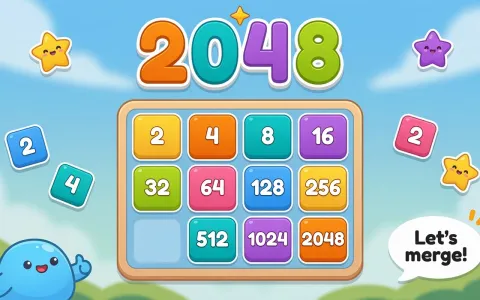 2048Merge the numbersPlay now
2048 was made by Gabriele Cirulli, a 19-year-old web developer from Italy, who built it over a single weekend and put it online for free in March 2014. He never planned a hit: the game was a coding exercise, a way to rebuild a puzzle he'd enjoyed on his phone. Within a week, millions of people were sliding tiles in their browsers, and within a month 2048 had become one of the most copied games ever made. Here's where the idea came from, why it spread so fast, and why the argument about who really invented it still matters.
Before 2048: Threes and 1024
The chain starts with Threes!, a mobile puzzle released in February 2014 by designer Asher Vollmer, artist Greg Wohlwend and composer Jimmy Hinson. Threes took more than a year to design. Its cards combine in a slightly awkward way on purpose — 1 and 2 make 3, then equal multiples of 3 merge — and every slide moves the board just one step, which keeps the player thinking about each move rather than mashing a direction.
Threes was a paid app, and within weeks of its release free look-alikes appeared. The most influential was 1024, which simplified the rules: only equal tiles merge, and tiles slide all the way across the board until they hit something. That change made the game faster and easier to pick up. Cirulli has said he saw a browser-based variant of 1024 and decided to write his own version from scratch as a programming exercise — that version became 2048.
2048Merge the numbersPlay nowMarch 2014: one weekend, one repository
Cirulli wrote 2048 in JavaScript and published the code on GitHub under an open-source licence on 9 March 2014, hosting the game itself for free on GitHub Pages. There was no app to install and no account to create — the whole game was a single web page that worked on a laptop or a phone. That matters for what happened next: a link to 2048 was the entire product, so sharing the game was as easy as sharing the link.
The link spread through Hacker News, Reddit, Twitter and Facebook, and the numbers took off. Cirulli later said the game had drawn around four million visitors in less than a week. For a project with no marketing, no studio and a nineteen-year-old maintainer, it was an absurd scale — and it kept growing for months, long after most viral games had faded.
Why it spread so fast
Part of the answer is the rules. 2048 has one move — slide everything in a direction — and one goal, and the very first game teaches you everything there is to know. Two 2s make a 4, two 4s make an 8, and the tile you're chasing is right there in the name. Nobody needed a tutorial, and nobody needed to explain the game to a friend: you just sent the link.
The other part is failure. A 2048 run ends with the board full and no merges left, and it is almost always the player's fault — one careless swipe pulled the big tile out of its corner. Losing that way feels fixable, and the next attempt is one click away. That loop, short runs and clearly-earned losses, is the same engine that has kept players inside Snake and Solitaire for decades.
Timing helped too. In early 2014 Flappy Bird had just been pulled from app stores, and the internet was primed for a simple game that everyone could argue about. 2048 fit that slot exactly, and unlike Flappy Bird it never disappeared, because it never lived in a store to begin with.
The clone argument
Threes' creators were not thrilled. In a long public post they described how their fourteen months of design work had been reduced to a free web page in a matter of weeks, and they laid out why they thought their deliberately harder rules made the better game. The debate — is 2048 a tribute, a clone, or a rip-off? — became one of the most cited discussions about game cloning of the decade.
Cirulli, for his part, always named his sources. He described 2048 as derived from 1024 and Threes, said he did not want to make money from something he considered someone else's idea, and kept the code open. In a strange way the openness is what sealed the game's place in history: because anyone could fork it, 2048 became the version everyone copied, rather than one of the copies.
The clones of the clone
Within weeks of launch, GitHub filled with forks. There were versions built around memes, versions where tiles were Fibonacci numbers or letters or logos, boards of 3x3 and 8x8, 3D and hexagonal grids, versions where you played against an AI, and versions where an AI played itself while you watched. Writing an AI solver for 2048 became a popular programming challenge in its own right, and a well-tuned solver reaches the 2048 tile almost every time.
The merge idea also escaped the grid. The 'combine two identical things to make a bigger one' rule that 2048 made universal turned up years later in physics form: the watermelon game that took over the charts in 2023 drops fruit into a jar, and equal fruits merge into the next size up. Melon Merge on crokocat is exactly that mechanic — a cherry at the bottom of the ladder, a watermelon at the top, and the same tension over running out of room that 2048 players know by heart.
 Melon MergeGrow the watermelonPlay now
2048 today
More than a decade later, the original web page still works and the game is still everywhere: on phones, in browsers, in maths classrooms and on the back of exam papers. It also remains a rite of passage for programmers, much as Snake was a generation earlier, because the whole thing fits in a few hundred lines of code and every rule is visible on the board.
crokocat's 2048 keeps the 2014 formula intact — the same 90/10 spawn odds for 2s and 4s, the same one-merge-per-move rule, the same option to keep going after you build the 2048 tile — and adds only what a modern browser build should: smooth animations, swipes on phones and a best score that survives between visits. If you want to go beyond nostalgia, our 2048 strategy guide covers the corner method that turns a lucky run into a repeatable one.
Frequently asked questions
Who made 2048?
2048 was created by Gabriele Cirulli, a 19-year-old Italian web developer, who wrote it over a weekend and released it for free on 9 March 2014. He published the source code openly on GitHub and has always credited 1024 and Threes as the games it was based on.
Is 2048 a copy of Threes?
It's a descendant. Threes (February 2014) introduced the slide-and-merge idea; 1024 simplified it to equal-tile merges with full slides; 2048 rebuilt the 1024 rules as a free web game. The creators of Threes publicly objected, and Cirulli acknowledged the lineage rather than disputing it.
Why is the game called 2048?
Because 2048 is the target tile. Tiles double with each merge — 2, 4, 8, 16 and so on — and 2048 is the eleventh power of two, high enough that reaching it needs a plan rather than luck. Many versions, including the one on crokocat, let you keep going toward 4096 and beyond.
Did Gabriele Cirulli make money from 2048?
By his own account he chose not to profit from the original web version because he considered the concept borrowed. The game was open source and free to play, which is a large part of why it spread and why so many variants exist.
Guides & tips
Play it here
- 2048 — Merge the numbers
- Melon Merge — Grow the watermelon
- Block Crush — Drag, fit, blast the lines