


Games like the watermelon game: merge puzzles worth your time
Published August 15, 2026 · Updated August 18, 2026
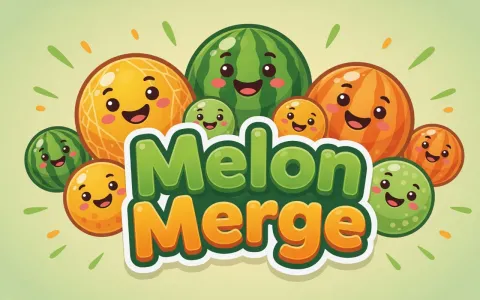 Melon MergeGrow the watermelonPlay now
If you want games like the Suika watermelon game and you want them in a browser tab right now, four are worth your time: Melon Merge, which is the fruit-dropping merge game itself, rebuilt to run in the browser; 2048, the same merge rule with numbers instead of physics; Block Crush, for the part of the itch that is really about running out of room; and Stack to the Stars, for the one-more-run part. All four are free on crokocat, with no download and no account.
What you are actually looking for
The watermelon game got its hooks in through a loop you can describe in one sentence: two identical things touch, they become one bigger thing, and the container never quite has enough room. In late 2023 a small Japanese physics puzzle built on that sentence became one of the most-watched games in the world and has stayed on the charts since, with a sequel arriving in early 2026.
But people who go looking for something like it are rarely after the fruit. They are after one of three things underneath: the merge itself, the slow squeeze of a filling container, or the five-minute run that ends in a mistake you immediately want to un-make. The useful question is not which game is the closest clone, but which half of the feeling you are chasing.
Melon Merge — the watermelon game, no install
Start here if you want the real thing. Melon Merge is our take on the merge-fruit mechanic: drop fruits into a jar, watch matching pairs squish into bigger fruit, and climb a ladder of ten — cherry, strawberry, grape, orange, apple, lemon, peach, pineapple, melon, watermelon — with each merge scoring more than the last.
Real 2D physics runs the jar, which is what separates this family from every grid-based merge puzzle. Fruits roll, settle, lean on each other and tumble into gaps, so every drop rearranges the whole pile and a single merge can cascade through it. The tension is spatial rather than mathematical: big fruits are worth big points but occupy enormous space, and the red line at the top of the jar is unforgiving — let any fruit rest above it and the run ends.
Good play looks like housekeeping. Park pairs in the corners, keep the middle open, sort cherries with cherries early, and think one merge ahead so a dropped grape lands next to two more. And when two watermelons finally meet, they vanish in a burst of fireworks — the rarest event in the game and the reason people record their runs. Aim with the mouse or your finger, click, tap or press Space to drop.
Melon MergeGrow the watermelonPlay now2048 — the same merge, stripped of physics
2048 is what the merge rule looks like when you remove gravity and randomness of shape and leave only the arithmetic. Slide the entire board up, down, left or right; every tile travels as far as it can; two equal tiles that collide fuse into their sum. Two 2s make a 4, two 4s make an 8, and the tile the game is named after sits a long way down that road.
The container pressure is still there: every slide spawns a new tile in a random empty cell, and sixteen cells is not many. Space is the real currency. The players who reach 2048 are not the ones who merge the most — they are the ones who park their biggest tile in a corner and never break formation without a reason.
This version keeps the 2014 original's rules, including the 90/10 spawn odds and the option to keep going after you win. If Melon Merge is the merge you feel, 2048 is the merge you can reason about — arrow keys or WASD on a keyboard, swipes on a phone.
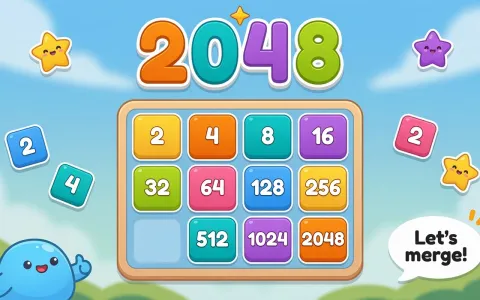 2048Merge the numbersPlay now
Block Crush — when what you miss is running out of room
Plenty of people who love the watermelon game are not really in it for merging. They are in it for the creeping dread of a board with nowhere left to put anything. Block Crush is that feeling on purpose: an 8x8 grid in the Block Blast family, three pieces at a time in the tray, and every full row or column blasts away.
The rule that makes it a puzzle rather than a reflex is that pieces cannot be rotated. An L-shape stays an L-shape, so you are planning rather than reacting — where do the next three go if I spend this corner now? There is no timer, and the run ends only when none of your remaining pieces fit anywhere, which means every loss is one you talked yourself into.
Scores live in the combos: clear on consecutive placements and each clear is worth more than the last, with a glowing preview showing which lines will blast before you commit. Keep a corner free for the 3x3 square and leave one open lane for the long pieces — the block-puzzle equivalent of keeping the middle of the jar clear.
 Block CrushDrag, fit, blast the linesPlay now
Stack to the Stars — the one-more-run half
The other half of the watermelon game's pull has nothing to do with puzzles. It is the short run, the self-inflicted mistake, the instant restart. Stack to the Stars distils that to a single button: a block slides back and forth above your tower, you tap to drop it, and anything that overhangs the block below gets sliced off and lost.
Nobody shoots at you and there is no clock. The only enemy is the millimetre you were off two floors ago, because every sloppy landing narrows the tower for every block that follows. Precision pays back in kind — land within a hair of perfect and the block snaps into place, and every third perfect drop in a row grows your tower wider again, so a sharp streak can undo minutes of bad play.
The climb is the reward: the tower starts on a daylight skyline, rises through a burning sunset into a starlit night, and finally out past where the air ends. Blocks slide faster the higher you go, and the best-height number follows you around until you beat it.
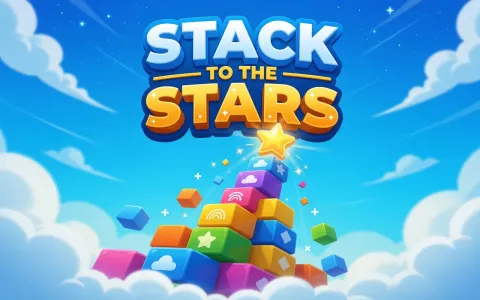 Stack to the StarsEndless stackingPlay now
Which one to open
Want the actual watermelon game and its physics: Melon Merge. Want the merge with the randomness dialled down so a loss is clearly a decision you made: 2048. Want the squeeze of a board filling up, with more room to plan and no gravity to fight: Block Crush. Want a five-minute score chase with one input and no thinking at all: Stack to the Stars.
All four are free, run in a browser tab on desktop, phone or tablet with nothing to install, and keep your best score on your own device.
Frequently asked questions
What games are like the Suika watermelon game?
The closest match is Melon Merge, which uses the same drop-and-merge fruit mechanic with real 2D physics. For the merge rule without physics, 2048 slides tiles and fuses equal numbers. For the filling-board pressure, Block Crush is an 8x8 block puzzle, and Stack to the Stars covers the short-run score chase.
Can I play the watermelon game online free without downloading it?
Yes. Melon Merge runs entirely in your browser on crokocat, free, with no download and no sign-up, on desktop, phone or tablet. Aim with the mouse or your finger and click or tap to drop the fruit.
What is a merge game?
A merge game is any puzzle where two identical items combine into one bigger item. In Melon Merge two matching fruits become the next fruit up a ladder of ten; in 2048 two equal tiles fuse into their sum. The pressure comes from the space merging frees up never quite keeping pace with what arrives.
Which merge game is easiest to learn?
2048 has the simplest rules — one gesture in four directions, one merge rule, no physics to fight. Melon Merge is just as easy to start but harder to control, because the fruits roll and settle wherever the pile puts them.
Do these games save my progress?
Best scores are stored locally on the device you play on, so you can close the tab and your record is still there from the same browser. There is no account and nothing to sync.
Guides & tips
Play it here
- Melon Merge — Grow the watermelon
- 2048 — Merge the numbers
- Block Crush — Drag, fit, blast the lines
- Stack to the Stars — Endless stacking