


Pyramid 13: solitaire rules and how to clear the pyramid
Published October 21, 2026 · Updated October 22, 2026
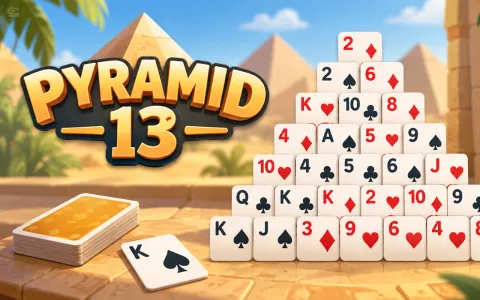 Pyramid 13Pyramid solitaire — pairs that make 13Play now
Pyramid solitaire is a pairing game: you take two open cards that add up to 13 off the table, or a King on its own, until the whole pyramid is gone. Ace counts 1, Jack 11, Queen 12, number cards are worth what they show, and suits do not matter at all. A card is open when no other card lies on top of it, and the top card of the open pile below the pyramid counts too. Everything else in this guide is about choosing which pair to take first.
The rules in one minute
In Pyramid 13 the deal is a pyramid of 28 cards with the rest of the deck waiting below it. On your turn you tap an open card, then a partner so that the two add up to 13, and the pair leaves the table. A King is worth 13 by itself, so you tap it once and it goes. That is the entire move set.
If no pair is available, tap the deck to turn a new card onto the open pile. When the deck runs out you can tap it again for another pass, as long as you have passes left. You win the deal when all 28 pyramid cards are cleared. Every deal in Pyramid 13 was checked by a solver before it was used, so a deal that looks stuck is a deal you can still win.
Which cards make 13
Memorise the pairs once and the game speeds up. Ace and Queen make 13 (1 + 12). Two and Jack make 13 (2 + 11). Three and 10, four and 9, five and 8, six and 7 do the same. Kings are the only cards that need no partner.
A handy way to think about it: every card has exactly one partner value, and it is 13 minus its own number. The Queen needs an Ace, the Jack needs a Two, and so on down the line. When you scan the open cards, you are really asking one question: is the partner of this card also open right now?
Dig into the pyramid from the bottom
Cards low in the pyramid are the ones sitting on top of the most other cards. A card in the bottom row lies over two cards above it, and clearing it is what makes them open. A card near the apex is covered until the rows below are gone. So when two different pairs are available, prefer the one that opens the cards that were buried deepest.
This is the first tip worth remembering: uncover cards low in the pyramid early. The pyramid only opens up as you work down through its middle, and every turn you spend on easy pairs while the lower rows stay full is a turn that does not make the next pair possible.
Take Kings at once, but be careful with the deck
Kings are free: they need no partner and removing one can only help. As soon as a King is open, take it. Waiting gains nothing, and a King left open is a card you might forget while you search for pairs.
The deck is where deals are won and lost. Do not pair two deck cards away if a pyramid card could have used one of them. A pyramid card is stuck until its partner shows up, while a deck card will come around again on the next pass. Spend a deck card on the pyramid whenever you can, and only match deck against deck when nothing else is possible.
When two partners are open for the same card, pick the one that frees more cards. If one candidate sits in the pyramid and the other on the open pile, ask which choice uncovers something new, and take that one.
Passes through the deck and how to earn three stars
The number of passes shrinks as you climb. Early levels let you go through the deck three times, from level 11 you get two passes, and from level 31 only one. With one pass left there is no second chance for a card you let go by, so slow down and check the open pile before every pair.
Three stars go to a deal cleared on the first pass through the deck. Plan for it from the first turn: keep track of which cards have already gone by in the deck, because on the next pass the same cards return in the same order. If you remember that the only Eight you needed was turned two cards ago, you will know what to dig toward before the deck comes back around.
A routine for every deal
Start each deal by taking any open King. Then scan the bottom rows for pairs, and only turn the deck when you have checked every open card against the top of the open pile. Before you confirm a pair, look at what it uncovers. Pairs that open a new card are better than pairs that do not.
Controls are simple: tap an open card, then its partner, or tap the deck to turn a card. On desktop you click instead. Pyramid 13 is free on crokocat, runs in the browser on desktop, phone and tablet, and needs no download or sign-up.
Frequently asked questions
What are the rules of pyramid solitaire?
Remove pairs of open cards that add up to 13, or a King on its own. Ace is 1, Jack 11, Queen 12. Turn cards from the deck when no pair is open, and clear the whole pyramid to win.
Which cards make 13 in Pyramid 13?
Ace and Queen, Two and Jack, Three and 10, Four and 9, Five and 8, and Six and 7. A King counts 13 by itself.
Can every Pyramid 13 deal be won?
Yes. Each deal was cleared by a solver before it was used, so every level can be completed.
How many times can I go through the deck?
Three times on early levels, twice from level 11 and once from level 31.
How do I get three stars in Pyramid 13?
Clear the pyramid on your first pass through the deck.
Guides & tips
Play it here
- Pyramid 13 — Pyramid solitaire — pairs that make 13