


Wild Eights: rules and how to empty your hand first
Published October 6, 2026 · Updated October 10, 2026
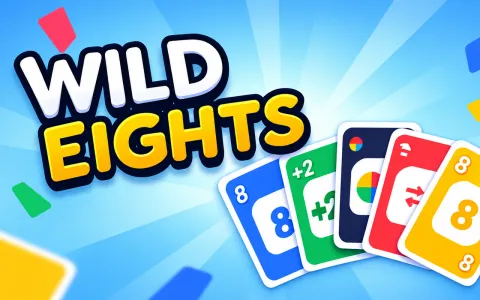 Wild EightsMatch the colour or the number — first to empty their handPlay now
Wild Eights is a shedding card game, and the rules fit in one sentence: on your turn, play a card that matches the colour, the number or the symbol on top of the pile, and the first player to run out of cards wins. If nothing fits, you draw from the deck. The strategy fits in one sentence too: hold your Wild cards back, use Skip, Turn and +2 when the next player is close to going out, and call the colour you hold most of. If you came looking for Crazy Eights rules, the idea is the same family of games, and this guide walks through exactly how Wild Eights plays, then what to do with each kind of card.
The rules in one minute
Wild Eights uses a 108-card deck in four colours. There are numbered cards, three action cards called Skip, Turn and +2, and two kinds of Wild: the plain Wild and the Wild +4. One card starts the pile, and everyone plays onto it in turn.
On your turn you play one card that matches the top card by colour, by number or by symbol. Cards you can play glow, so you never have to hunt for a legal move. If nothing in your hand fits, tap the deck to draw a card; if the card you draw fits, you may play it, and if not your turn ends. The round is over the moment someone plays their last card.
In the levels you play against one computer player at first, then two, then three. Against one opponent you need to go out first. Against two or three you pass the level by finishing in the top two, and going out first earns three stars.
What the action cards do
Skip passes the next player, so they lose their turn. Turn reverses the direction of play, and the direction arrows on screen show who goes next. With only two players, a Turn works like a Skip, because the order has only two seats to swap. +2 makes the next player draw two cards.
Wild cards go on anything, and you choose the colour that comes next. That makes a Wild the most flexible card in your hand and also the easiest to waste. Everything below comes back to one question: is this the right moment to spend it?
Keep your Wilds for the moments nothing else fits
The most useful habit is to treat a Wild as insurance. When you have a matching card in a normal colour, play that card and keep the Wild. The Wild earns its place on the turn when your hand has no match at all, because it saves you a draw and lets you pick a colour you are strong in.
There is one exception: your last cards. If playing a Wild would leave you with one card, or let you go out, play it. Holding it for a better moment only gives an opponent time to get ahead of you.
Time Skip, Turn and +2 for the right moment
Action cards do two jobs: they get rid of a card from your hand, and they take something away from another player. Playing one early gets you only the first job. Playing one when the next player is close to going out gets both, because a Skip or a +2 on a player who is about to go out can undo their whole round.
So when you have a choice between a number and an action card, look at the opponents first. If nobody is close, play the number and keep the action in reserve. If the next player is close to going out, hit them now. A Turn is the quiet one of the three: it is the card to play when the player who is about to go out sits right after you, because it sends the turn the other way, to someone with a bigger hand.
Which colour to call after a Wild
Whenever you play a Wild, you pick the colour, and the easiest rule is also a good one: pick the colour you hold most of. Every card of that colour in your hand becomes a playable card on your next turn, and that sets up a run of plays in a row.
A second habit helps even more. Count which colours you have few of and get rid of those cards early, together with your high numbers. A lone card in a colour is hard to play later, because it only fits when that colour is on the pile. Clearing the awkward ones first leaves you with a hand that is mostly one or two colours, and that is a hand you can empty.
Reading the table
The pile, the direction arrows and the other hands you can see at the table are enough to make good decisions. Watch the direction arrows after every Turn, because a Turn changes who plays after you, and with it who your Skip or +2 will land on.
When an opponent draws repeatedly, they probably lack the colour on the pile. If you can, stay on that colour, or call it with a Wild, and they may keep drawing. The computer players get sharper as you climb the levels, so leaving a single card in your hand for too long gets more expensive the higher you go.
Where to go next
Wild Eights teaches the habits that carry over to other card games: counting what is left, saving the flexible card, and timing the hit. If you want a game where tricks and suits matter more, try Heartbreak, the classic Hearts against three computer players, or Spade Call, partnership Spades where your team has to make its contract. For a quieter card game, Pyramid 13 asks you to clear a pyramid by pairing open cards that add up to 13.
 HeartbreakHearts — dodge the hearts and the Queen of spadesPlay now
 Spade CallSpades with a partner — bid it, then make itPlay now
 Pyramid 13Pyramid solitaire — pairs that make 13Play now
Frequently asked questions
How do you play Wild Eights?
Play a card that matches the colour, number or symbol on top of the pile. If you cannot, draw from the deck. The first player to empty their hand wins the round.
Is Wild Eights the same as Crazy Eights or Uno?
It belongs to the same family of shedding card games: match the colour or the number, use Skip, Turn, +2 and Wild cards, and be first to empty your hand. Wild Eights is crokocat's own game with its own card design, and it is not affiliated with Uno.
What does the Turn card do?
It reverses the order of play. With only two players it works like a Skip.
When should I play a Wild card?
Keep it for turns when nothing else fits, or play it when it lets you go out. Then choose the colour you hold most of.
How do I pass a level?
Against one computer player, go out first. Against two or three, finish in the top two. Going out first earns three stars.
What happens if I cannot play a card?
Tap the deck to draw one. If it fits you may play it; otherwise your turn ends.
Guides & tips
Play it here
- Wild Eights — Match the colour or the number — first to empty their hand
- Heartbreak — Hearts — dodge the hearts and the Queen of spades
- Spade Call — Spades with a partner — bid it, then make it
- Pyramid 13 — Pyramid solitaire — pairs that make 13