


Word search tips: how to find every word faster in Letter Sweep
Published November 12, 2026 · Updated November 25, 2026
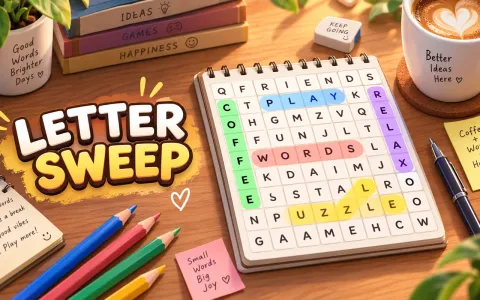 Letter SweepWord search on 3D letter tiles — drag across, find every wordPlay now
The fastest way to solve a word search is to stop reading the grid line by line and hunt for anchors instead: a rare letter such as Q, Z, X, J or K, a pair of letters that starts a word, or a long word that is hard to hide. Find the long words first, then let the leftover letters point you to the short ones. On harder grids, remember that a word can run diagonally or backwards, so check every direction from an anchor before you move on. This guide shows how those habits play out in Letter Sweep, a free themed word search on 3D letter tiles, and how to turn them into three stars on every level.
How Letter Sweep works
Each level has a theme, such as fruit, animals, the ocean, space or music, and a list of words under the grid. Every word on the list is hidden in a straight line. To claim one, press on its first letter, drag to its last letter and let go. A right word glows in the theme's colour, hops and is ticked off; a wrong line simply slides back.
Two details make the game kinder than a paper puzzle. The selection snaps to one of the eight straight directions, so a slightly shaky finger still draws a clean line. And every grid is checked so that each word appears exactly once: the random letters around it never spell a second copy by accident. When you find a word, you have found the only one.
Know which directions to check on each level
The biggest time saver is knowing where words can and cannot be. Letter Sweep climbs gently. Levels one to three are seven by seven grids with five words that only run across and down. Diagonals join at level four on an eight by eight grid. From level eleven the grid is nine by nine and words can also run backwards and up the diagonals. From level twenty-six the grid is ten by ten with eight words running in any of the eight directions.
Use that to your advantage. On an early level, there is no point tracing a diagonal: read each row left to right and each column top to bottom and you will see everything. Add one direction at a time as the ladder adds them. Players who check all eight directions from level one waste most of their time looking where no word can be.
Hunt rare letters first
Common letters like E, A and S appear all over a grid, so starting your search from them is slow. A Q, Z, X, J or K is different: there are only a few of them, and each one is a strong hint. If a word on the list contains a rare letter, find that letter first and look at its eight neighbours for the next letter of the word.
Double letters work the same way. A word with OO, LL or EE in it has a pair that stands out when you scan a row, and the pair narrows the search to a handful of spots. Themes help here too: a fruit list or a space list often has one oddly spelled word, and that word is usually the quickest to pin down.
Long words before short ones
A long word is easier to spot than a short one, because it takes up a lot of the grid and its letters are hard to blend into the noise. Start with the longest word on the list. Once it is found, it stays lit, and the grid you still need to search gets smaller.
Short words are the opposite. Three or four letters can hide almost anywhere, and you will often see their first two letters in several places. Leave them for last, when found words have already filled in most of the board and the unlit letters are the only places left to look.
Scan for letter pairs, not single letters
When a word has no rare letter, look for its first two letters together. Finding every T in the grid tells you little; finding a T with an R right next to it, in any direction you are allowed to check, gives you a short list of real candidates. Follow each candidate one more letter and most of them will die after the third letter.
On levels with backwards words, run the same check from the end of the word. Reversed, the last two letters are a pair you can scan for just as easily, and a word that refused to show up forwards often jumps out once you look for its ending.
Getting three stars
There is no penalty for a wrong drag in Letter Sweep, so a line that you are almost sure about is worth trying straight away rather than double-checking. Stars come only from speed: find every word within the level's par time and you get three. A fast, slightly risky drag beats a slow, careful one.
A good order for a three-star run is simple. Glance at the list and pick out the longest word and any word with a rare letter. Find those first. Then work through the remaining words, using the lit tiles to rule out parts of the grid. If one word is still missing at the end, read the unlit letters along every direction the level allows; it is almost always sitting in the last empty patch.
Your level, stars and best are saved on your device, and the highest level goes on the leaderboard. The ladder is endless and cycles through fifteen themes, so there is always a next grid.
Frequently asked questions
What is the fastest way to solve a word search?
Start from anchors instead of reading line by line: rare letters, double letters and the longest word on the list. Once those are found, the leftover letters show you where the short words are hiding.
Which directions do words run in Letter Sweep?
Across and down on the first levels, diagonally from level 4, backwards and up the diagonals from level 11, and in all eight directions from level 26.
Is there a penalty for a wrong line?
No. A wrong drag just slides back. Stars depend only on how quickly you find every word, so trying a likely line is always worth it.
Can the same word appear twice in the grid?
No. Every Letter Sweep grid is checked so each word on the list can be read in exactly one place.
Is Letter Sweep free?
Yes. It runs free in the browser on desktop, phone and tablet with no download and no sign-up. On a phone, hold it upright.
Guides & tips
Play it here
- Letter Sweep — Word search on 3D letter tiles — drag across, find every word