


Bolt Out: how to solve the screw puzzle
Published November 14, 2026 · Updated November 25, 2026
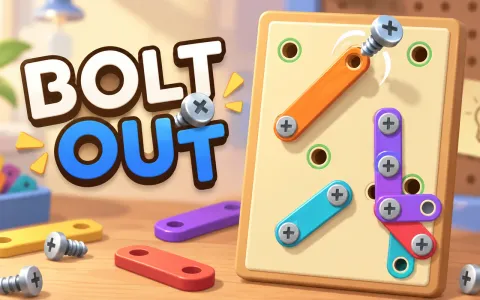 Bolt OutScrew puzzle — unscrew, move, drop every platePlay now
To solve a screw puzzle like Bolt Out, work from the top down: free the plate lying on top first, because it is usually the one covering the holes you need. Treat every empty hole as a resource, never park a screw where you will have to move it again, and look for a screw that pins two plates at once, since taking it out can drop both. If you get stuck, undo a few moves or tap the bulb for a good next move. The rest of this guide explains why those rules work and how to turn a solved board into a three-star one.
The two rules that decide every board
Bolt Out has colourful plates screwed to a board in layers and only a few free holes. You tap a screw to lift it and tap a glowing hole to put it there. A plate that has no screws left falls away, and the level is done when every plate has dropped.
The first rule: a screw pins every plate that has a hole where the screw sits. If two plates overlap and both have a hole at that spot, one screw holds both of them. That is why a single move can sometimes drop two plates, and why a careless move can lock two plates in place.
The second rule: you can only put a screw into a hole if every plate lying over that hole has a hole there too. A plate that covers the spot without a hole blocks it. The game shows this for you, because the glowing holes are exactly the ones you can use. When a hole you wanted is dark, a plate is lying over it.
Almost every mistake in a screw puzzle comes from forgetting one of these two rules, so it is worth reading each board with them in mind before the first tap.
Start with the plate on top
The plate lying on top of the stack is usually the one blocking holes. Until it drops, the holes underneath it stay dark, and the plates below have nowhere useful to send their screws. Freeing the top plate first opens the board up for everything that follows.
Look at the top plate and count its screws. Then look for free holes those screws can go into without pinning anything new. On the early boards this is often enough to start a chain: the top plate falls, two or three holes light up, and the next plate down has room to move.
On bigger boards the top is not always a single plate. Bars across the board, diagonals and L-shaped plates can sit over several others at once. Treat each of them the same way: which plate covers the most holes you need? That one goes first.
Guard your free holes
Free holes are the most precious thing on a Bolt Out board. Every time you park a screw in one, it is gone until that screw moves again. The fastest way to get stuck is to fill holes with screws you will have to move a second time.
Before you place a screw, ask two questions. Does this hole sit under a plate I still need to free? If so, the screw will pin that plate too, because the plate has a hole there, and you have just added work. And is there a hole that leads nowhere, off to the side of the stack, where the screw can rest without touching anything you care about? That is usually the better spot.
A good habit is to keep at least one free hole open for as long as you can. Boards with a single spare hole leave you no room to correct a move, and the later levels, which grow up to nine plates, rarely forgive a fully packed board.
Use screws that pin two plates
Because one screw can pin every plate that has a hole under it, some screws hold two plates at once. These are your best moves. If both plates have no other screws, lifting that one screw drops both of them.
The same rule works against you when you place a screw. Put it in a hole that sits over two plates and it now holds both. So the strongest pattern on a board is this: take screws out of spots where they pin several plates, and put them into spots where they pin as few as possible, ideally none you still need.
When you scan a board, look for the stacked holes where plates overlap. They tell you which screws are worth moving first and which holes to avoid when you put a screw down.
From solved to three stars
Every level in Bolt Out is checked by a solver, so every board has a solution. The solver also finds the fewest moves the board needs, and that number is shown on the level. Match it and you get three stars.
Each screw you move counts as a move, but undo does not cost you anything. That makes undo the main tool for a three-star run: play the board once to learn which plate really blocks the rest, then undo back to the start and play it again with fewer wasted moves. Restart is free as well when you would rather begin from a clean board.
Most extra moves come from parking a screw in a temporary spot and moving it again later. If your count is above the target, look for a screw you touched twice. There is almost always a hole where it could have gone the first time.
When you are stuck
You can park screws badly in Bolt Out, and sometimes a board reaches a point where nothing useful glows. That is not the end of the level. Undo a few moves and look at what changed, or tap the bulb, which shows a good next move from wherever you are.
The hint is a fair way to learn a pattern you have not seen yet. Use it once, then try to see why that move works, usually because it frees a hole under the top plate or pulls a screw that pins two plates.
There is no timer, so there is no reason to rush. Bolt Out is a calm logic puzzle with 150 solver-checked boards, and more are generated past that. It is free on crokocat and runs in the browser on desktop, phone and tablet with no download. On a phone it plays best held upright; on a computer you click a screw, then click a hole.
Frequently asked questions
What is the trick to solving a screw puzzle?
Free the plate on top first, keep your empty holes for screws that will not need to move again, and pull screws that pin two plates at once, since that can drop both.
Why can't I put a screw in that hole?
A plate lies over the hole without a hole of its own there. Only the glowing holes can take a screw.
Does undo count as a move in Bolt Out?
No. Undo does not cost moves, but every screw you move counts toward the total that decides your stars.
How do I get three stars?
Clear the board in the fewest moves shown on the level. The number comes from a solver that checked every board.
How many levels does Bolt Out have?
There are 150 solver-checked boards that grow from two plates to nine, and more are generated past that.
Guides & tips
Play it here
- Bolt Out — Screw puzzle — unscrew, move, drop every plate