


Cube Jam guide: how to clear every cube before your moves run out
Published September 12, 2026
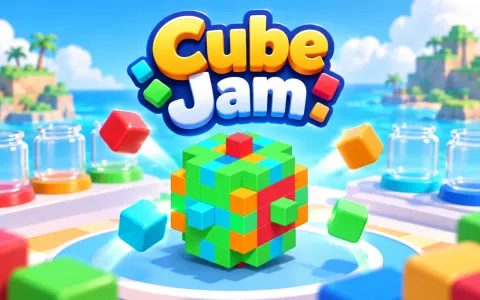 Cube JamClear the shape, color by colorPlay now
Cube Jam gives you one action and one constraint. Tap a cube and it disappears along with every cube of the same colour touching it face-to-face, however large that group turns out to be; the rest of the figure settles inward to close the gap. The constraint is the move limit, and a level only counts if the shape is completely gone before the limit runs out. So every tap is a question of size: did that move take five cubes or thirty-five? Players who lose levels are almost never stuck — they have been clearing the groups they could see instead of the groups that were there. This guide covers how groups behave in three dimensions, why spinning the figure is a move in itself, what the colour jars are telling you, how the three stars are scored, and how to use settling rather than be surprised by it.
One rule, three dimensions
The rule is that a group is every cube of the same colour connected face-to-face, and tapping any cube in a group removes all of it in a single move. On a flat board that would be easy to count. On a solid figure it is not, because connection happens in six directions instead of four and most of those connections are out of sight.
The consequence is worth stating plainly: two red patches on opposite sides of the shape may be one group running straight through the middle, and a single red square on the surface may be the visible tip of the largest group in the level. Nothing on the outside of the figure tells you which. Reading the shape means forming a guess about what the colours are doing inside it, then checking that guess by turning the figure around.
This is also why the game is not a speed puzzle. Drag to spin, scroll or pinch to zoom, tap to clear — the controls are three gestures and the first two are free. The only resource you spend is moves.
Spin before you tap, every time
Turning the figure costs nothing, and the biggest group is rarely the one facing you when the level opens. That makes the spin the cheapest advantage in the game and the one most players skip because the shape looks legible from the angle it loaded at.
A workable habit: before the first tap, rotate through all six broad views and pick the colour that appears on the most faces rather than the colour that covers the most area on one face. Colour spread across many faces suggests a group threading through the body of the shape; colour concentrated in one flat patch is often exactly as big as it looks, and no bigger.
Zoom matters for the same reason. Pulling in close on a seam lets you see whether two same-coloured cubes actually share a face or merely meet at an edge, and that distinction decides whether you are about to make one move or two.
The jars are your map of what is hidden
Cleared cubes do not simply vanish. They fly into a row of jars, one per colour, and each jar fills as you clear that colour. The jars are presented as satisfying feedback, and they are, but they are also the only readout you get on what the shape still contains.
Use them subtractively. If the blue jar is nearly full and you can still see plenty of blue on the surface, then almost all the remaining blue is in front of you and it is probably one manageable group. If the green jar has barely moved and green is scarce on the surface, there is a large amount of green buried somewhere — and clearing the layers above it is worth moves in its own right.
The jars also flag the mistake you cannot otherwise see: a colour you have been nibbling at in small clears. A jar that has crept up across four or five moves is a colour you took apart instead of taking out.
Settling is a tool, not a side effect
When a group goes, the rest of the shape settles inward to fill the space. That means the figure you are looking at after a clear is not the figure you planned against, and connections that did not exist a moment ago may exist now.
So a big early clear does two useful things: it pays for itself in cubes removed, and it rearranges the interior, frequently pushing same-coloured cubes together into a larger group than either of them was before. Clearing a big group early opens the shape up and can expose bigger groups underneath. This is the opposite of most puzzle instincts, where you save your strongest move — here the strong move compounds.
The corollary is that planning more than two moves ahead is wasted effort. Plan the move you are making and form a rough expectation of what it will expose; then look again, because the shape has changed.
Move limits and the three stars
Every level has its own move limit, tuned to how that particular shape actually solves rather than to its number, so a visually busy figure is not automatically the tighter one. Finishing right at the limit earns one star. Finishing with moves to spare earns two. Matching the level's optimal solution earns all three.
That scoring tells you what three stars requires, and it is not caution — it is efficiency. Optimal means no move was spent on a group that could have been cleared as part of a larger one later, and no move was spent clearing a colour in two passes when settling would have joined it into one. Every extra tap is a star moving away from you.
Levels worth replaying are therefore the ones you cleared with one star, not the ones you failed. A one-star finish means you solved it and spent the whole budget doing so, which is the exact profile of a level where a better order is sitting there waiting.
Restarting, the Daily Puzzle, and the long campaign
The reset button is not an admission of defeat. Clearing colours in a different order changes what is reachable later, so a level that has closed down on you is usually one where an early small clear fragmented a colour you needed whole. Restart, take the biggest visible group first, and the same level frequently solves with moves left over.
The Daily Puzzle is one extra shape a day, the same for every player, with its own move limit and star rating, and it does not touch your campaign progress. That makes it the right place to experiment — try the move you are unsure about, since nothing in the campaign is riding on it.
The campaign itself runs to 500 levels and the shapes escalate in kind, not just in size: plain tiles and cubes early, then spheres, octahedra, cuboctahedra, rhombic dodecahedra, spiky stars, drums and spires. Each family hides colour differently — a sphere buries its centre behind every face at once, while a spire hides almost nothing but gives you very few faces to read from. Progress and stars are saved in the browser, so the useful way to play a 500-level campaign is in short sittings, closing the tab and picking the shape back up later.
The short version
Spin through every side before the first tap. Pick the colour that shows up on the most faces, not the one with the biggest flat patch. Take the largest group you can find early and let settling build you a bigger one. Read the jars to work out what is buried. Never clear a colour in two moves that could have gone in one. Restart without hesitation when the order has gone wrong, and save your experiments for the Daily Puzzle.
Frequently asked questions
How do you play Cube Jam?
Tap any cube and it is removed along with every cube of the same colour connected to it face-to-face, all in a single move. The rest of the shape settles inward to fill the gap. Drag to spin the figure and scroll or pinch to zoom, and clear every cube before your move limit runs out to finish the level.
How do you get 3 stars in Cube Jam?
Three stars requires matching the level's optimal solution. Finishing right at the move limit gives one star and finishing with moves to spare gives two, so three stars is about never spending a move on a group you could have cleared as part of a larger one.
What do the jars in Cube Jam mean?
Each jar tracks one colour, and every cube you clear flies into its matching jar. They let you see how much of a colour is left inside the shape without spinning it around and counting, which is the main clue to where the large hidden groups are.
Why can I see a colour but not clear much of it?
Because a group is only the cubes of that colour touching face-to-face. Two patches of the same colour on different parts of the shape can be separate groups, and cubes that meet only at an edge are not connected — zooming in on the seam is the fastest way to tell.
How many levels does Cube Jam have?
500 campaign levels, each with its own move limit, plus a new Daily Puzzle every day that is the same for every player and does not affect your campaign progress.
Is Cube Jam free, and does it save my progress?
Yes to both. It runs free in the browser on desktop, phone or tablet with no download and no sign-up, and your level and stars are stored locally so you can close the tab and come back to them.
Guides & tips
Play it here
- Cube Jam — Clear the shape, color by color
- Arrow Cube — Clear every arrow off the cube
- Rainbow Sort — Roll every marble into its color