


Code Quote tips: how to crack a number cryptogram without using your hints
Published October 16, 2026 · Updated October 17, 2026
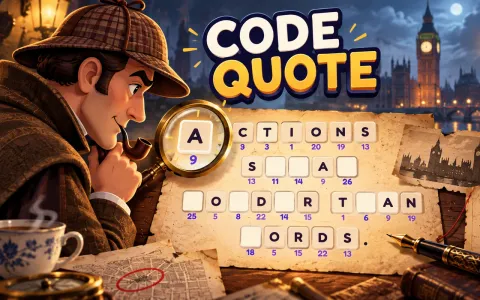 Code QuoteCrack the number code, reveal the sayingPlay now
The fastest way into a cryptogram like Code Quote is to ignore the long words and start with the short ones. A word with a single cell is almost always A or I, a three-letter word that keeps turning up is probably THE, and one right letter fills every cell that shares its number. That is how a single guess opens half a sentence. This guide shows how to pick your first letters, how to read double letters and apostrophes, how to use the keyboard to narrow choices and how to finish a saying with three hearts and three stars. If you know Figgerits or other cryptogram apps, the habits carry straight over.
How a Code Quote level works
Every level is a familiar English saying written in numbers. Each number from 1 to 26 stands for one letter, and the same number is always the same letter. A few letters are already shown when the level opens, and a fresh key is used on every level, so what worked as 7 yesterday means nothing today.
Tap an empty cell, then tap a letter on the keyboard, or type it on a computer. If the letter is right, every cell with that number fills in at once. If it is wrong, you lose one of your three hearts, and the third wrong letter ends the level. Finish without a mistake and you earn all three stars.
That one rule shapes the whole strategy: guesses are cheap only when you are nearly sure. Your job is to build certainty from the letters you can see, not to try letters until one sticks.
Start with the shortest words
Short words give themselves away. A word that is a single cell can only be A or I, so that is the first place to look. If the saying has such a word at the start, it is more often I or A, and the neighbouring words usually tell you which.
Next, look for a three-letter word that appears more than once, or for the same three numbers repeating across the sentence. THE is the most common three-letter word in English, so that pattern is a strong first guess. Once THE is in, you also know T, H and E everywhere else they appear, and the long words start to show their shape.
Do not begin with the longest word. It has the most cells, but also the most possible answers. Start where the number of possibilities is smallest and let the rest follow.
Read double letters and apostrophes
When the same number appears twice in a row inside a word, you are looking at a double letter. In English the usual suspects are LL, SS, EE, OO and TT. If the word is also short or sits next to a letter you already know, the choice narrows quickly.
An apostrophe is the other gift. A word, an apostrophe and then a single cell is very often a contraction: DON'T, CAN'T or IT'S. The single cell after the apostrophe is then likely T or S, which gives you a letter that appears in many sayings.
Write down a guess in your head before you tap, and ask what else it would force. If the letter you are about to place would make another word impossible, it is the wrong letter and you have saved a heart.
Use the keyboard to narrow your choices
The on-screen keyboard greys out the letters that are already placed. That is more useful than it looks: as the level fills in, the list of letters that are still unused gets shorter, and so does the list of candidates for each empty cell.
When a word has only two or three letters missing, compare what is left on the keyboard with the word's pattern. If the word is S _ A N D and the keyboard still has T, then the answer is staring at you. If a cell could be several letters, leave it, and solve a different word first.
That last habit matters most. Because a right letter fills cells everywhere, solving a word on the other side of the sentence can reveal the letter you were stuck on. Moving on is not giving up, it is how a cryptogram is meant to be solved.
Hearts, bulbs and getting three stars
You have three hearts per level. A short video can give you one more heart when you run out, once per level, but it is much better to treat the three you start with as the budget for the whole saying.
The bulb reveals a letter: the one in the selected cell, or the one that opens the most cells. You begin with three, the stock carries over between levels, and a video refills it. A good rule is to use a bulb only when every empty word has at least two plausible answers. A bulb spent early, on a cell you could have worked out later, is a bulb you will miss on a long saying.
The first levels are short sayings with many letters shown. They get longer and barer as you climb, so the habits above matter more with every level. Your level and stars are saved in the browser, and the leaderboard ranks the highest levels reached.
Frequently asked questions
What is the best first letter to try in Code Quote?
Start with a word that is a single cell: it is almost always A or I. After that, look for a repeating three-letter word, which is often THE.
What happens when I put in a wrong letter?
You lose a heart. After three wrong letters the level ends, and a short video can give you one more heart, once per level.
Does a right letter fill every matching cell?
Yes. Every cell with the same number fills in at once, which is why one good guess can open much of the sentence.
How do I get three stars?
Solve the saying without a single mistake. Stars depend on how many wrong letters you make.
Can I play Code Quote without downloading anything?
Yes. It is free on crokocat and runs in your browser on desktop, phone and tablet.
Guides & tips
Play it here
- Code Quote — Crack the number code, reveal the saying