


21 Match tips: how to clear every board in exactly 21
Published August 31, 2026
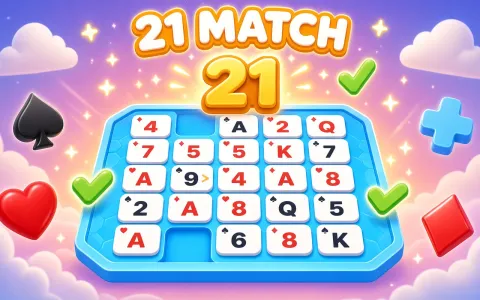 21 MatchClear the board in groups that add up to 21Play now
21 Match asks two things of every group you take: the cards have to be connected, and they have to add up to exactly 21 — face cards counting 10, aces counting 11. Hit the number and the group clears. Go over it and the group busts, the selection resets, and the move is gone anyway. That last detail is where most levels are actually lost, and it is the reason the single most useful habit in the game is counting down from 21 rather than adding up from zero.
The two rules, and what they cost
Here is the whole game in one paragraph. Tap cards one at a time, or drag across them, to build a group; the running sum shows above the board. Every card you add has to touch the selection — directly, or across an empty gap left by cards you already cleared. Land on exactly 21 and the group disappears and costs you one move. Land above 21 and you bust: the selection clears and the move is spent regardless. New cards fall in from the top to fill the holes, so the board you finish a level on is never the one you started with.
Read that cost structure carefully, because it is unusual. In most puzzle games a mistake is free and only wastes time; here a bust and a clear are priced identically. A careless tap is worth exactly as much as a good one, so the discipline that wins levels is not faster play but slower confirmation — check the sum before the last tap, especially when the move counter is in single digits.
Count down from 21, not up from zero
Adding cards until you reach 21 makes you the servant of whatever you happened to tap first. Working backwards makes the board answer to you. Find the 10 or the face card first — anything worth 10 — and ask a single question: what pairs with this to make 21? An ace does it alone, because an ace is 11 and 11 plus 10 is exactly the number. That makes ace-and-ten the cheapest clear in the game, two cards for one move, and it is also the one players most often walk straight past while hunting for something more elaborate.
After the two-card pairs, the arithmetic settles into a handful of shapes worth recognising on sight: a 10 with a 6 and a 5, a 10 with a 7 and a 4, a 9 with a 7 and a 5, three sevens. No table to memorise — just the habit of starting from the biggest card in a neighbourhood and subtracting, because the biggest card constrains the group far more than the small ones do.
The corollary is a warning about aces. Eleven is a lot. An ace plus a nine is 20, which looks nearly there and is in fact nowhere: nothing worth 1 exists on the board. Treat every ace as a card looking specifically for a ten.
Connection is looser than it looks
The connection rule is the part of 21 Match players read once and then quietly misapply for a dozen levels. Cards have to touch the selection side by side — diagonals do not count — but the empty gaps left by cleared groups do not break the chain. Two cards on opposite sides of a hole are still connected. Gaps conduct.
That single fact opens groups that look impossible. Late in a level, when the board is more hole than card, the reachable neighbourhood of any card is far larger than the eye suggests, and the group you dismissed three moves ago as 'not touching' may now be legal. When a board looks stuck, re-check across the holes before spending a move on something mediocre.
Clear low, because the refill comes from above
New cards drop in from the top. That makes where you clear a strategic choice, not just an arithmetic one. Take a group along the top row and you disturb very little: the replacements land more or less where the old cards were and the rest of the board sits untouched. Take a group low on the board and everything above it shifts down while fresh cards pour into the space — you have effectively reshuffled a whole column for the price of one move.
Use that deliberately. When the board is rich in options, clear high and preserve the good groups you have spotted lower down. When the board has gone stale, clear low on purpose to churn it. The move costs the same either way; the difference is how much new material you get back. It also explains why a group you are saving may not survive the group you just took — if two clears are available and one sits underneath the other, bank the fragile upper one first.
When the goal stops being 21s and starts being suits
The Adventure campaign runs 400 levels, and it does not stay still. Boards widen from a small square to a full spread, the move allowance tightens, and somewhere around level ten the objective changes character: instead of 'make five 21s' the level starts asking for hearts, or spades, or three suits at once. The arithmetic is unchanged, but what counts as a good group is not.
On a suit goal, a group of 21 that happens to be all one suit does double duty — it satisfies the sum and banks suit progress in the same move. Hunt for those before taking anything else, because a mixed 21 on a suit level spends a move and delivers only a fraction of the target. When no single-suit group exists, favour the one carrying the most cards of the suit you need.
The wider late boards make this easier than it sounds. More cards on screen means more ways to reach 21, and with the gap rule in play there is usually a suit-friendly version of the group you were about to take, one or two cards to the side.
Hints, hearts and the two daily modes
You carry three hints, and each one lights up a group that works. Spend them on a genuinely locked board rather than on impatience: clearing a new Adventure level earns one back, so a hint used to get unstuck partly pays for itself while a hint used to skip thinking does not. The daily modes run with no hints at all.
Lives are five hearts shared across Adventure. Failing a level costs one and they refill on their own over time, so a bad run costs time rather than progress; levels you lose come back. From level sixteen onward, clearing a new level also starts a short wait before the next one opens — three minutes at first, ten later on — though levels you have already cleared stay open, and you get one free skip to spend whenever you like.
The two daily modes ask for different things. Daily Survival is five levels in a row from the day's seed with three lives for the whole run, once per day — a sharp test rather than steady progress. Daily Streak is a single level picked near your current progress, identical for you every time you open it that day; clear it and the day counter goes up, miss a day and it resets. Streak play rewards caution above all, since there is no second attempt. Progress — level, stars, streak — saves in your browser, and signing in on crokocat moves that record onto your account instead.
Play it free, and where to go next
21 Match runs free in the browser on crokocat with no download and no sign-up, on desktop, phone or tablet. Tap cards one by one or drag across them; tap a selected card again to drop it, or tap the board to start the selection over — that reset is free, which is why you should never finish a group you already know is wrong.
If the counting is what pulls you in, Solitaire on the same portal scratches the same card-sense in a slower form. If it is the board-clearing rhythm, Gem Sort is the closer relative: different rules, same shape of thinking, where the scarce resource is space rather than moves and the winning habit is again spending it only on purpose.
 Gem SortSort the sparklePlay now
Frequently asked questions
How do you play 21 Match?
Tap or drag across cards to build a connected group adding up to exactly 21 — face cards count 10, aces count 11. Hit 21 and the group clears for one move; go over and it busts, costing the move anyway. Meet the level's goal before the moves run out.
Is 21 Match the same as blackjack?
No. It borrows the number 21 and the card values and nothing else. There is no dealer, no betting and no hidden cards — the whole board is visible, and the puzzle is choosing which connected group to take.
What counts as a connected group?
Every card has to touch the rest of the selection side by side. Diagonals do not count, but the empty gaps left by cleared cards do not break the chain — two cards on opposite sides of a hole are still connected, which opens groups that look impossible at a glance.
What is the best 21 Match tip for saving moves?
Count down from 21 instead of up from zero. Find the card worth 10 first and ask what pairs with it — an ace is 11, so ace-and-ten is the cheapest clear in the game. And confirm the sum before the last tap, because a bust costs the same move a clear does.
What happens when I run out of hearts?
Hearts are lives, five of them, shared across Adventure. Failing a level costs one and they refill on their own over time, so a bad run costs waiting rather than progress — the levels you lost are still there when you return.
Is 21 Match free to play?
Yes. It runs in your browser on crokocat with no download and no sign-up, and your level, stars and streak save automatically.
Guides & tips
Play it here
- 21 Match — Clear the board in groups that add up to 21
- Solitaire Blast — Klondike with a deal of the day
- Gem Sort — Sort the sparkle