


TriPeaks vs Pyramid solitaire: how the two games differ
Published November 17, 2026 · Updated November 25, 2026
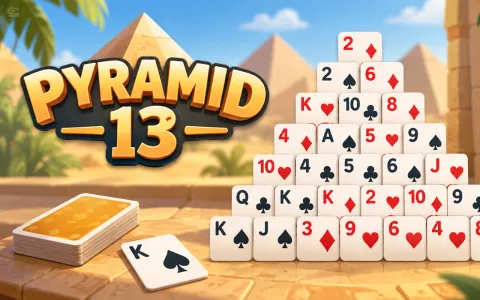 Pyramid 13Pyramid solitaire — pairs that make 13Play now
TriPeaks and Pyramid look alike at first glance: both lay out 28 cards in triangular shapes, both have a deck below, and in both the suits do not matter. The difference is how a card leaves the table. In Pyramid you remove two open cards that add up to 13, or a King on its own, so the game is about pairs and simple sums. In TriPeaks you move one card at a time onto a pile, and it must be one rank higher or lower than the card on top, so the game is about long runs. Below is how the two compare in practice, using the rules of Pyramid 13 and Three Peaks, the two versions you can play free on crokocat.
The layout: one pyramid or three peaks
Pyramid 13 sets out 28 cards as one pyramid, with a deck below. A card is open when no card lies on it, so at the start only the bottom row can be used, and every pair you remove opens cards higher up.
Three Peaks also uses 28 cards, but stacks them into three peaks over a bottom row of ten. Only that bottom row starts face up. When the two cards resting on a face-down card are gone, it turns over and joins the game. So in TriPeaks you do not know every card in the layout from the start, which changes how far ahead you can plan.
Pyramid 13Pyramid solitaire — pairs that make 13Play now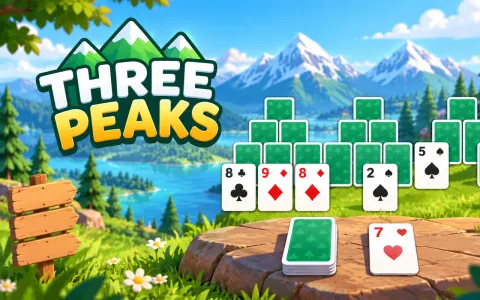 Three PeaksTriPeaks solitaire — one up or one down, clear the three peaksPlay now
How cards leave the table: pairs or runs
This is the core difference. In Pyramid 13, Ace counts 1, numbers count as shown, Jack is 11 and Queen is 12, and you remove two open cards that add up to 13: a 6 with a 7, a 4 with a 9, a Jack with a 2. A King is 13 by itself and goes alone. The top card of the open pile below the pyramid counts as an open card too, so it can pair with a pyramid card.
In Three Peaks there is no adding. You look at the open card at the bottom and play any uncovered card one rank above or below it, which then becomes the new open card. On a 7 you can play a 6 or an 8, then a 7 again, and so on. Kings and Aces are neighbours, so the ranks run in a circle. The streak of cards you play without drawing from the deck is the heart of the game, and in Three Peaks each step of it plays a higher note.
The deck: passes or a single run
In both games you tap the deck when nothing fits, but the deck works differently. Pyramid 13 lets you go through the deck more than once: three times on early levels, twice from level 11 and only once from level 31. That makes memory useful, because a card you skipped on the first pass will come round again.
In Three Peaks the deck is limited and each card you turn over starts the streak again. There is no second pass to fall back on, so every draw costs you something, and the skill is in choosing which uncovered card to play before you reach for the deck.
Which one is harder?
Neither game is harder in every way, they test different things. Pyramid asks you to spot pairs that make 13 and to plan which partner to use when two are open, since one choice can free more cards than the other. It is slower and more like a small arithmetic puzzle. TriPeaks is faster and asks you to look along a run: 6, 7, 8 and back to 7 can clear four cards from a single open card.
Many players find TriPeaks easier to pick up because one rule covers everything: one up or one down. Pyramid takes a few deals to get used to the sums, but once they are automatic it feels very calm. In both of our versions every deal is played through by a solver before you get it, so every level can be won, and the question is only how well you play it.
Stars and goals
In Pyramid 13 you win by clearing all 28 pyramid cards, and you earn three stars by clearing the deal on your first pass through the deck. In Three Peaks you win by clearing all three peaks, and the stars depend on how many cards are still left in the deck: eight or more is three stars, and the leftover cards flip over as a bonus.
So both games reward the same thing in the end, wasting as few deck cards as possible. Pyramid measures it in passes, TriPeaks in cards.
Which one should you play first?
If you like quick decisions and the feeling of a long streak, start with Three Peaks. Its first deal teaches itself: a hand points at a card you can play, or at the deck when nothing fits. If you prefer a slower game where you look at the whole layout and plan pairs, start with Pyramid 13 and remember that Kings are free, so take them as soon as they open.
Both games are free on crokocat, run in the browser on desktop, phone and tablet, and need no download. Trying a deal of each is the quickest way to find out which family of solitaire suits you.
Frequently asked questions
What is the main difference between TriPeaks and Pyramid solitaire?
In Pyramid you remove pairs of open cards that add up to 13, or a King alone. In TriPeaks you play single cards onto a pile, each one rank higher or lower than the card on top.
Is TriPeaks easier than Pyramid solitaire?
Many players find TriPeaks easier to learn because its only rule is one up or one down. Pyramid needs quick sums to 13, which takes a few deals to get used to.
Do suits matter in TriPeaks or Pyramid?
No. In both games only the rank of a card counts, never its suit.
Can every deal be won?
In Pyramid 13 and Three Peaks, yes. Every deal is played through by a solver before it is used, and deals it cannot clear are thrown away.
Do Kings work the same way in both games?
No. In Pyramid a King counts 13 and is removed on its own. In TriPeaks a King sits next to the Queen and, on most levels, the Ace, so it is part of a run.
Guides & tips
Play it here
- Pyramid 13 — Pyramid solitaire — pairs that make 13
- Three Peaks — TriPeaks solitaire — one up or one down, clear the three peaks