


Stickman Run: when to jump, when to fire the rope
Published September 4, 2026
 Stickman RunRun the tunnel, swing the ropePlay now
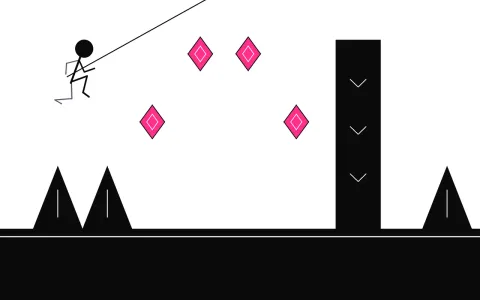
Stickman Run is a one-tap endless runner through a black-and-white tunnel, and the whole skill of it fits in one question: is the thing ahead something you jump, or something you rope? Tap to jump the spikes, blocks and holes. Double-tap to fire a rope at the ceiling when a wall is taller than your jump — those walls are built that way on purpose, and no amount of timing gets you over one on foot. Everything else in this guide hangs off that split: the road signs tell you which move is coming before the hazard is on screen, the speed decides how early you have to commit, and the pink gems decide whether a mistake ends the run or just interrupts it.
Two gestures, one button
There is no joystick and no second button. A single tap (Space, W or the up arrow on a keyboard) jumps. A double-tap fires the rope diagonally forward into the ceiling, where it snaps onto the marked rings if there is one ahead of you, winches you up and throws you forward when you let go. Tap once more while you are hanging to release early. On a keyboard, Shift or the down arrow fires the rope directly without the double-tap, which is worth learning because it removes the one timing ambiguity the game has.
The third move is hidden inside the first. When the runner is pinned against a steep climb, a tap does not jump so much as kick off the wall and push you up a step. It only counts when the feet are back on the wall, so a rhythm of taps carries you up a climb while a mash of taps leaves you scrabbling in place.
Read the signs, not the hazards
Road signs slide in from the right ahead of every hazard: a climb, a drop, a hole, spikes overhead, a wall that needs the rope. By the time the obstacle itself is on screen you are already too close to change your mind at speed, so the sign is the real cue and the hazard is the confirmation. Train yourself to react to the sign and the game stops feeling like a reflex test and starts feeling like reading.
The two signs that matter most are the ones that look similar and demand opposite things. The rope sign means start your double-tap early, because the hook takes a moment to grab the ring and haul you up. The downward-blades sign means the exact opposite: ceiling spikes are hanging over this stretch, so stay on the floor and run under them. Jumping there is the single most common way a promising run ends, because jumping is what your thumb wants to do whenever it sees something black.
Holes: leave as late as you dare
A gap in the floor is a jump, but it is a jump with a specific timing. Leaving the lip at the last instant gives you the whole arc of the jump to cover the hole; leaving early spends half the arc over solid ground and lands you short. The instinct is to jump the moment you see the edge. Fight it, especially early in a run when the speed is low and there is time to wait.
Speed changes the arithmetic. You get faster the further you go, so a hole that was a comfortable hop at three hundred metres becomes a committed leap at a thousand. The tunnel is generated as you run, and it never flattens out — it climbs, plunges and pinches down so low that jumping means cracking your head on the ceiling. Past the first few hundred metres, decide the move on the sign and stop reconsidering when the gap comes into view.
The rope: hook early, release on purpose
The tall walls cannot be jumped, so the rope is not an optional trick — it is the only way past a whole class of obstacle. Two habits make it reliable. First, fire early: the hook needs a moment to reach the ring and start winching, and a rope fired when you are already at the wall arrives late. Second, treat the release as a decision. The longer you hold, the higher and further the swing carries you. Let go at the top for distance over a wall; let go early if the sign after the wall says the ceiling gets low.
If you liked the swing in Stickman Hook, this is that feeling wired into a runner, but with one difference worth noticing: the rope winches you up rather than just swinging you, which is why holding a beat longer changes your height so much. Players who release by reflex, at the same moment every time, clear some walls and clip others. Players who release according to the next sign clear them all.
Gems and resurrects: how to buy a longer run
Pink gems sit along the route, sometimes in a clean line, sometimes arced over a hole so that collecting them costs you a riskier jump. They are the only thing that carries over: gems bank across every run and stay in your browser. When you die you can spend five hundred to get back up where you fell, with the ground around you cleared and a couple of seconds of grace. The second resurrect in the same run costs a thousand, the third fifteen hundred, and so on.
That pricing is the real strategy layer. A resurrect deep in a run is worth far more than the handful of gems you skipped to stay safe, so the rule is: take the gems arced over a hole when your speed is low, skip them at full pelt, and bank before you get greedy. Then decide in advance how many resurrects a run is allowed to eat. Five hundred for the first one is almost always worth it once you are past your usual death point; fifteen hundred for a third is usually a sign that this tunnel has beaten you and the gems are better spent on the next attempt.
Use the seed to practise instead of praying
Every run is built from a seed, and the seed is in the address bar. The same seed gives the identical tunnel — the same spikes in the same places, the same walls, the same holes. That turns an endless runner into something you can rehearse. Found a tunnel that keeps killing you in the same spot? Copy the link, reload it, and grind that section until the sign-to-move reflex is automatic. Paste it to a friend and you can argue about who read it better on a fair comparison.
Put a name in and your best distance goes on the leaderboard with everyone else's. If you want a second one-button game from the same portal to sharpen the same skill, Stack to the Stars trains the other half of it: a block slides across the screen, you tap to drop it, and whatever hangs over the edge gets sliced off. Different tunnel, same lesson — react to the rhythm, not the picture.
 Stack to the StarsEndless stackingPlay now
A high-score checklist
React to the sign, not the hazard. Never jump under the downward-blades sign. Fire the rope before you reach the wall, and choose the release moment by what comes next. Leave holes as late as you dare, and leave them earlier as the speed climbs. Tap in rhythm on steep climbs rather than mashing. Take arced gems slow, skip them fast, and set a resurrect budget before the run starts. Stickman Run is free on crokocat in the browser on desktop, phone and tablet with nothing to install — tap anywhere to jump, double-tap for the rope, and see how far the tunnel lets you go.
Frequently asked questions
How do you use the rope in Stickman Run?
Double-tap the screen, or press Shift or the down arrow on a keyboard. The rope fires diagonally forward into the ceiling and locks onto the marked rings when one is ahead of you, winches you up and flings you forward when you release. Fire it early — the hook needs a moment to grab — and tap again while swinging to let go.
Why can't I jump over the tall walls?
They are built taller than your jump on purpose. When the rope sign slides in from the right, start your double-tap before you reach the wall and let the rope carry you over. There is no jump timing that clears one on foot.
What do the road signs mean?
Each sign warns you about the next hazard before it is on screen: a climb, a drop, a hole, ceiling spikes or a wall that needs the rope. The downward-blades sign means stay on the floor and run under the spikes — do not jump there.
What are the pink gems for?
They bank across runs and stay in your browser. When you die you can spend 500 to resurrect where you fell with the hazards cleared and a moment of grace. The second resurrect in the same run costs 1000, the third 1500.
Does Stickman Run ever end?
No. The tunnel is generated as you run and gets faster and denser with distance, so every run ends when you touch something black. Your best distance goes on the leaderboard if you enter a name.
Guides & tips
Play it here
- Stickman Run — Run the tunnel, swing the rope
- Stack to the Stars — Endless stacking