


Sliding path puzzles explained: why you can't stop halfway
Published November 2, 2026 · Updated November 25, 2026
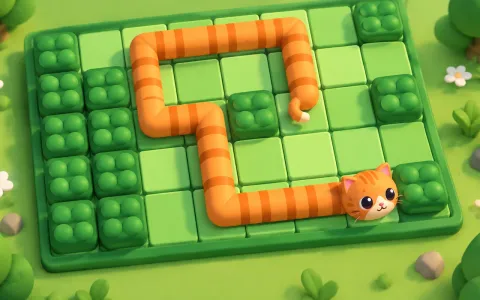 Long PawsSwipe the long cat until the garden is fullPlay now
A sliding path puzzle is a puzzle where your piece, once sent in a direction, keeps going until something stops it. You never choose how far to move, only which way, and the whole challenge is to arrange a route where the things that stop you are in the right places. The pattern turns up in ice-floor puzzles, in long-cat games where a stretching cat fills a garden, and in a family of grid puzzles that all ask the same question: in what order do you commit to your moves? This article explains how the genre works and what to look for on a board.
The one rule: direction yes, distance no
Most puzzle games let you decide exactly where a piece ends up. A sliding path puzzle takes that choice away. You pick up, down, left or right, and the piece runs in a straight line until a wall, an edge or another object is in its way. On a typical board that leaves you three or four possible moves at any moment, and often only one or two of them are sensible.
That sounds like it should make the game simpler, and in a way it does: the move list is tiny. What makes it hard is that every move is final in a way a normal move is not. The piece cannot stop one square short of the trap, so a bad slide often lands you in a position you cannot leave.
The ice-floor tradition
The most familiar form is the ice floor, a staple of video games for a long time: you step on slippery ice, and you glide until you bump into something solid. Players learn to treat obstacles as brakes. A rock, a wall or a pillar is not just something in the way, it is the only place you are able to stop, so a good route is a chain of brakes.
That shift in thinking is the core skill of the genre. You stop asking where you want to go and start asking where you can stop, and which stop lets you slide somewhere useful next.
Adding a trail: the long-cat version
Long Paws adds one twist to the sliding idea: the piece leaves a body behind it. Its ginger cat runs in a straight line until a hedge, the edge of the garden or its own body stops it, and its body stretches over every cell it passed. The goal is to fill every patch of grass with cat.
The trail changes what a mistake looks like. In a plain sliding puzzle you can usually wander back. Here the cat's own body becomes a wall, so a bad run can seal off a pocket of grass that the cat can no longer reach. Long Paws has no undo, so if the cat is boxed in with grass left over, the level starts again. Each level is built backwards from a working route, with the hedges placed where the cat has to stop, which means a full route always exists, but plenty of tempting first moves lead nowhere.
Long PawsSwipe the long cat until the garden is fullPlay nowFilling every square is a famous kind of problem
Asking for a route that visits every square exactly once is a classic idea in mathematics, where such a route is called a Hamiltonian path. You do not need the maths to enjoy the games, but it explains why they feel the way they do: the order matters more than any single move, and the last few squares are always the awkward ones.
Link Lines comes at the same idea from another angle. Every colour has two dots to connect, lines cannot cross, and each puzzle is made from one long path through every square that has been cut into pieces, so a solution that fills the whole board always exists. Filling every square earns three stars. The route is something you draw, not something you slide, but the thinking is the same: commit to the cramped corners first.
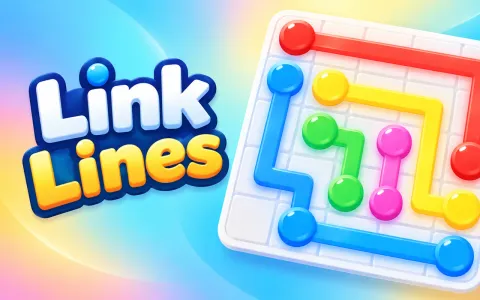 Link LinesConnect the dots — link every pair and fill the boardPlay now
Pushing instead of sliding: the sokoban cousin
Box Bunny belongs to a related family. It is sokoban in a garden: a bunny pushes crates onto pads, but never pulls them, so every push is permanent. A crate pushed into a corner can never come out again. Like a sliding path puzzle, it punishes moves that cannot be reversed and rewards looking several steps ahead.
The difference is that Box Bunny has an undo and a restart, and a counter for the fewest pushes. The shared lesson is the one that matters: when moves cannot be taken back, the planning happens before the move, not after.
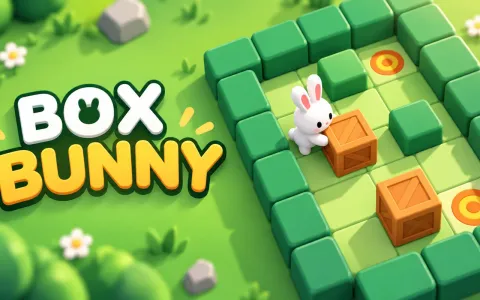 Box BunnySokoban with a bunny — push every crate onto a padPlay now
How to read a board before you move
Start by finding the stopping points: every edge, wall or obstacle where your piece could end a slide. Then look for the corners and pockets that can only be reached in one way, because those have to be entered at the right time. Work out which squares will be hardest to reach later and plan to take them early or last, depending on whether entering them blocks you in.
Then run the route in your head, one slide at a time, and count what is left after each. If a slide cuts the board in two, ask whether you can still finish both halves. That one question avoids most dead ends, and it is as useful in a garden full of hedges as on a floor of ice.
Frequently asked questions
What is a sliding path puzzle?
A puzzle in which your piece keeps moving in a straight line until something blocks it. You choose the direction, never the distance, so planning where you can stop is the whole game.
Is it the same as a sliding tile puzzle like the 15-puzzle?
No. In a tile puzzle you shift tiles one space into a gap to arrange them in order. In a sliding path puzzle one piece glides across the board until it hits an obstacle.
Why can't I stop halfway in Long Paws?
That is the idea of the game: the cat always runs until a hedge, the edge of the garden or its own body is in the way, and its body fills every cell it passed.
Does every level in these games have a solution?
In Long Paws every level is built backwards from a route that fills it, and in Link Lines every puzzle is cut from one path through every square, so a full solution always exists.
Which of the three is the best place to start?
Link Lines is the calmest, since you draw lines and can drag back to shorten them. Box Bunny adds undo and restart. Long Paws is the strictest, because it has no undo.
Guides & tips
Play it here
- Long Paws — Swipe the long cat until the garden is full
- Link Lines — Connect the dots — link every pair and fill the board
- Box Bunny — Sokoban with a bunny — push every crate onto a pad