


Wave Dash: how to control the wave and survive longer
Published October 10, 2026 · Updated October 26, 2026
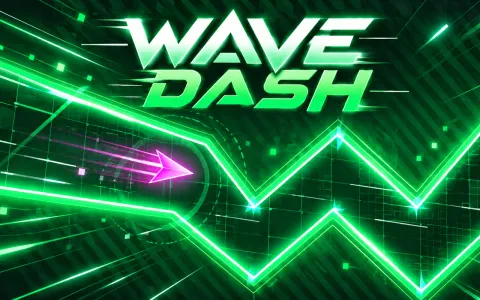 Wave DashHold to climb, let go to divePlay now
The wave in Wave Dash is easier to control than it looks, once you stop treating the button as hold or release and start treating it as a rhythm. The arrow always travels at 45°: up while you hold, down when you let go. Tap in short bursts and it stays level; hold longer and it climbs; release longer and it dives. If you came here after searching for Geometry Dash wave tips, the idea is the same, and this guide covers short taps, where to look, how to pass spikes, how to find the rhythm of a section and when to use the flag.
Think in short taps, not long holds
There is only one control: press and hold anywhere on a touch screen, or hold Space or the up arrow on a keyboard, and the arrow flies up at 45°. Let go and it dives at 45°. There is no neutral. The arrow is always going up or down, so the way to hold a height is to alternate quickly.
Hold, release, hold, release: that is how you keep the arrow level inside a corridor. The trail behind the arrow draws what you are doing, and a tidy zigzag with small teeth means your taps are short and even. A trail with big swings means you are holding too long, and big swings are what hit the walls.
Most early crashes come from over-correcting. The arrow drifts toward a wall, the player holds or releases hard to get away and flies straight into the opposite wall. Make the correction as small as the problem: one slightly longer press or one slightly longer release, then go back to short taps.
Watch the wall ahead, not the arrow
Your eyes want to follow the arrow, but the arrow is already where your input has put it. What you need to know is where the corridor goes next, so look a little ahead of the arrow at the glowing walls as they rise, fall and narrow.
If the next stretch climbs, start a slightly longer hold before the wall moves. If it drops, give a slightly longer release. Reacting only when the wall is next to you is too late at higher speeds, because the corridor changes faster than you can correct.
Every level is built around a safe zigzag path, so it can always be flown. When a section looks impossible, it is not. The path is there, and your job is to find the timing that stays on it.
Pass spikes on the open side
Later levels hang pink spikes from the ceiling and stand them on the floor wherever there is room. They go where the corridor is wide, so a spike is a hint about where the safe space is, not just a threat.
Pass a spike on the open side: if it stands on the floor, fly above it, and if it hangs from the ceiling, fly below it. Start the move early so you are already on the open side when you reach it, instead of swerving at the last moment. Squeezing past a spike by a pixel works once and then fails, so give it room.
Remember that the walls still count. A spike near a narrow part of the corridor leaves little room, so set your height before the narrowing starts.
Find the rhythm of each section
The zigzags in a section repeat their timing. After a couple of attempts you will notice that the same pattern of holds and releases fits the same stretch, and the stretch stops being a surprise.
Use the crash as information. The bar at the top marks your best progress, so you can see how far a try got you. Short levels mean a run takes only a few seconds, so treat each attempt as a test of one idea: tap a little shorter, look a little further ahead, or start the climb a beat earlier.
The early levels are wide and slow, and they are the place to build the habit of short, even taps before the speed rises and the corridor tightens. Every level also opens with a wide, calm lead-in, so use that stretch to find your rhythm before the first zigzag.
Use the flag and stars wisely
The flag button starts you from a save point along the level, near your best progress. You begin with one flag, flags carry over between levels, and a short video refills them. That makes them worth keeping for the last stretch you keep missing, not the first wall you hit.
Stars are for clearing a level in few tries: clear it on the first try for three stars, in a few tries for two. A flag helps you finish a level, but a level cleared from a save point is not the same as a first-try clear, so if you want three stars, play the level fresh, learn the tough part, and come back.
A good routine is to clear the level with a flag if you must, then return later and play it from the start for the stars. Your level, stars and flags are saved in the browser, so nothing is lost when you leave.
If you want more one-tap practice
One-button games train the same habit: a single input, timed well. Wingbeat asks you to tap to flap through gaps, Drift Line has you hold anywhere to steer up-right and let go to steer up-left on a zigzag sky road, and Key Jumper trades timing for slime parkour across a giant keyboard.
Playing a few rounds of Wingbeat or Drift Line is a good break from Wave Dash when your taps get tense. Tension is the other big cause of crashes: a tight grip on the button makes long holds, and long holds hit walls. Relax your hand, breathe, and go back to short, even presses.
Wave DashHold to climb, let go to divePlay now WingbeatTap to flap through the gapsPlay now
 Drift LineOne-tap drifting on a zigzag sky roadPlay now
Frequently asked questions
How do I control the arrow in Wave Dash?
Press and hold anywhere on the screen, or hold Space or the up arrow, to fly up at 45°. Let go to dive at 45°. That is the only control.
How do I keep the arrow level?
Alternate short holds and short releases. The arrow is always rising or falling, so quick taps keep its average height steady inside the corridor.
Is Wave Dash like the Geometry Dash wave?
It plays like the wave mode: a 45° arrow that climbs while you hold and dives when you let go. Wave Dash is a separate game by crokocat with generated corridors.
Is every level possible to clear?
Yes. Each corridor is built around a safe zigzag path that the arrow can always fly, so a section that looks impossible has a way through.
What does the flag do?
It starts you from a save point near your best progress. You begin with one, they carry over between levels, and a short video brings more.
How do I get three stars?
Clear the level on the first try for three stars, or in a few tries for two.
Guides & tips
Play it here
- Wave Dash — Hold to climb, let go to dive
- Wingbeat — Tap to flap through the gaps
- Drift Line — One-tap drifting on a zigzag sky road
- Key Jumper — Slime parkour across a giant keyboard