


The history of the advent calendar: from chalk marks to puzzle doors
Published November 21, 2026 · Updated November 25, 2026
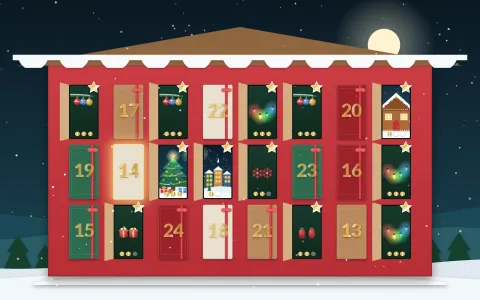 Advent 24One door a day — a Christmas puzzle behind each of 24 doorsPlay now
The advent calendar started in Germany in the 19th century, when Protestant families counted down to Christmas with chalk marks on a door, a candle lit each day or a straw laid in the crib. The first printed calendar sold in shops is usually credited to Gerhard Lang, a printer who produced one in the early 1900s; little doors arrived in the 1920s, and chocolate behind them only after the Second World War. So nobody invented the advent calendar in a single moment. It grew from a home custom into a printed product, then into a sweet, then into almost anything with 24 doors, including the daily puzzle calendars you can now open in a browser. Here is how it got there.
Before paper: counting the days at home
Advent is the season of waiting before Christmas, and for centuries it was marked in church rather than at home. In the 19th century German Protestant families began to make the countdown visible for their children. The simplest way was a row of chalk marks on a wall or a door, one wiped away for each day that passed. Others lit a candle every day, or let a child add one straw to an empty crib each day, so that the bed for the baby Jesus was ready by Christmas Eve.
The earliest known handmade advent calendar is usually dated to 1851. Homemade versions spread through the second half of the century: a picture hung up each day, a verse from the Bible on a slip of paper, a small gift. What they shared was the idea that is still the point today, that a child can see how many days are left and has something to do on each of them.
Gerhard Lang and the first printed calendar
The man most often called the inventor of the advent calendar is Gerhard Lang, a German printer. As a boy, the story goes, his mother made him a calendar for December. Accounts disagree on what it was: some say 24 small biscuits sewn onto the lid of a box, one to eat each day, others say 24 little pictures fixed to a piece of card. Either way, the memory stayed with him.
In the early 1900s Lang's printing firm produced what is widely considered the first commercial advent calendar, drawn by the illustrator Ernst Kepler. It had no doors yet. Children got a sheet of pictures to cut out and a sheet with numbered spaces, and glued one picture on each day. Around the same time, a German newspaper also gave away an advent calendar as an insert, a sign that the idea was in the air.
In the 1920s Lang's calendars gained the feature everyone knows now: little doors to open, one for each day, with a picture hiding behind each. That turned the calendar from a craft sheet into a small daily surprise, and by the 1930s advent calendars were in high demand across Germany.
War, Stuttgart and the road to America
The Second World War stopped the trade. Paper and cardboard were rationed, and the Nazi government banned the printing of illustrated calendars.
After the war the custom came back quickly. Richard Sellmer, a publisher in Stuttgart, became the best-known maker of advent calendars, and the tradition spread well beyond Germany. In the United States, the calendars got a famous push in 1953, when newspapers ran a photo of President Dwight Eisenhower opening one with his grandchildren.
Chocolate behind the doors
The first chocolate advent calendars reportedly appeared in the 1950s, but for years they stayed a small part of the market. In 1971 the British confectioner Cadbury began producing chocolate calendars commercially, and about two decades later chocolate calendars were in continuous production and on supermarket shelves every autumn.
From there the format opened up to anything that fits behind a door. Today there are advent calendars of toys, building bricks, tea, cosmetics, socks and puzzles. Some of them start before December or run past the 24th, but the classic shape has held: 24 doors from the first of December to Christmas Eve.
Why the countdown still works
The advent calendar has outlasted most other old Christmas customs because it does two things at once. It answers a child's question, how long until Christmas, with something they can see and count. And it turns a long wait into 24 small rewards, so the waiting itself becomes part of the fun.
That second idea is why the calendar moved so easily from paper to screens. A door that opens only on its own day gives a reason to come back tomorrow, and the size of the reward matters less than the ritual of opening it. A picture, a square of chocolate and a short puzzle all work the same way.
A puzzle behind every door
Advent 24 on crokocat is an advent calendar of this newer kind. A paper-cut house has 24 numbered doors, and behind each one waits a short Christmas puzzle: sorting baubles on the tree, matching ornament pairs, sliding a festive picture back together or turning wires until a garland lights up. The puzzles get harder towards Christmas Eve, and door 24 is a whole Christmas tree to light.
It keeps the old rule of one door a day. The doors open by the clock on your own device: in late November the first three are open as a sneak peek, and in December door N opens on day N. One thing it does better than paper is forgiveness. Every door that has opened stays open, so a day you missed can be played later, and a finished door gets a gold star sticker on its picture.
Advent 24One door a day — a Christmas puzzle behind each of 24 doorsPlay nowFrequently asked questions
Who invented the advent calendar?
The custom grew out of 19th-century German homes. The first printed calendar sold in shops is usually credited to the German printer Gerhard Lang in the early 1900s.
When did advent calendars get doors?
In the 1920s. Lang's earliest printed calendars were sheets of pictures to cut out and glue on, one for each day.
When did chocolate advent calendars start?
The first ones reportedly appeared in the 1950s. Cadbury began producing them commercially in 1971.
Why does an advent calendar have 24 doors?
It counts the days from the first of December to Christmas Eve, the 24th, which is when Christmas is celebrated in Germany, where the calendar began.
Is there an advent calendar with puzzles instead of chocolate?
Yes. Advent 24 on crokocat has a Christmas puzzle behind each of its 24 doors, free in the browser with no download.
Guides & tips
Play it here
- Advent 24 — One door a day — a Christmas puzzle behind each of 24 doors